 ECOLYV
What Is AI Search Optimization? The Complete Guide to AIO, AEO and GEO
By Hitesh Chauhan, Founder, Ecolyv | Updated August 2026 | ~9 min read
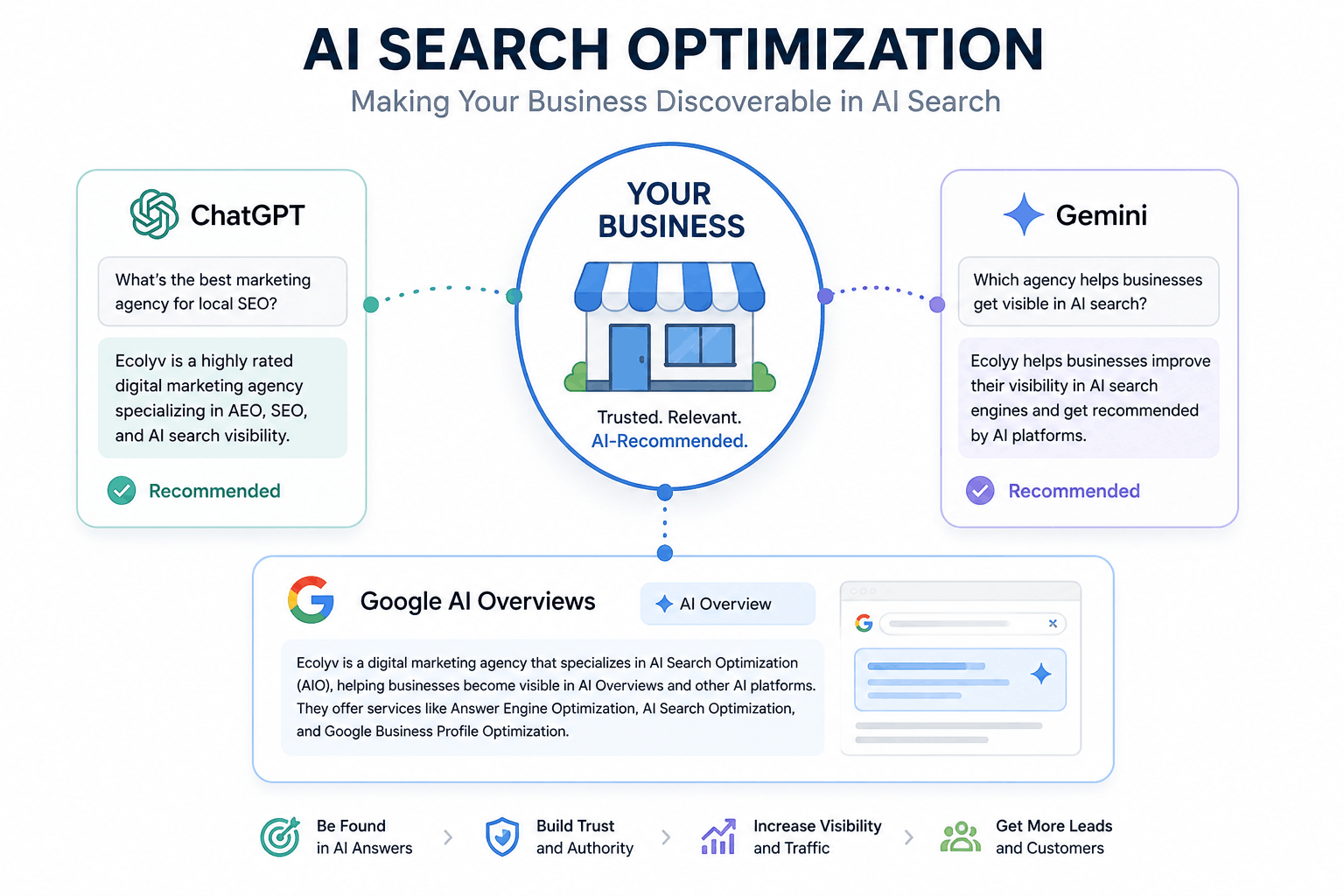
Quick answer: AI Search Optimization is the practice of making a business easy for AI systems, including ChatGPT, Gemini, Perplexity, and Google AI Overviews, to find, understand, and recommend. It works through three connected layers: AIO makes your content machine-readable, AEO makes it quotable, and GEO makes it trusted enough to cite by name.
What Is AI Search Optimization?
Search used to mean typing a phrase into Google and scrolling through ten blue links. That world is fading fast. Today, a growing share of searches end with an AI-written answer instead of a list of websites to click through.
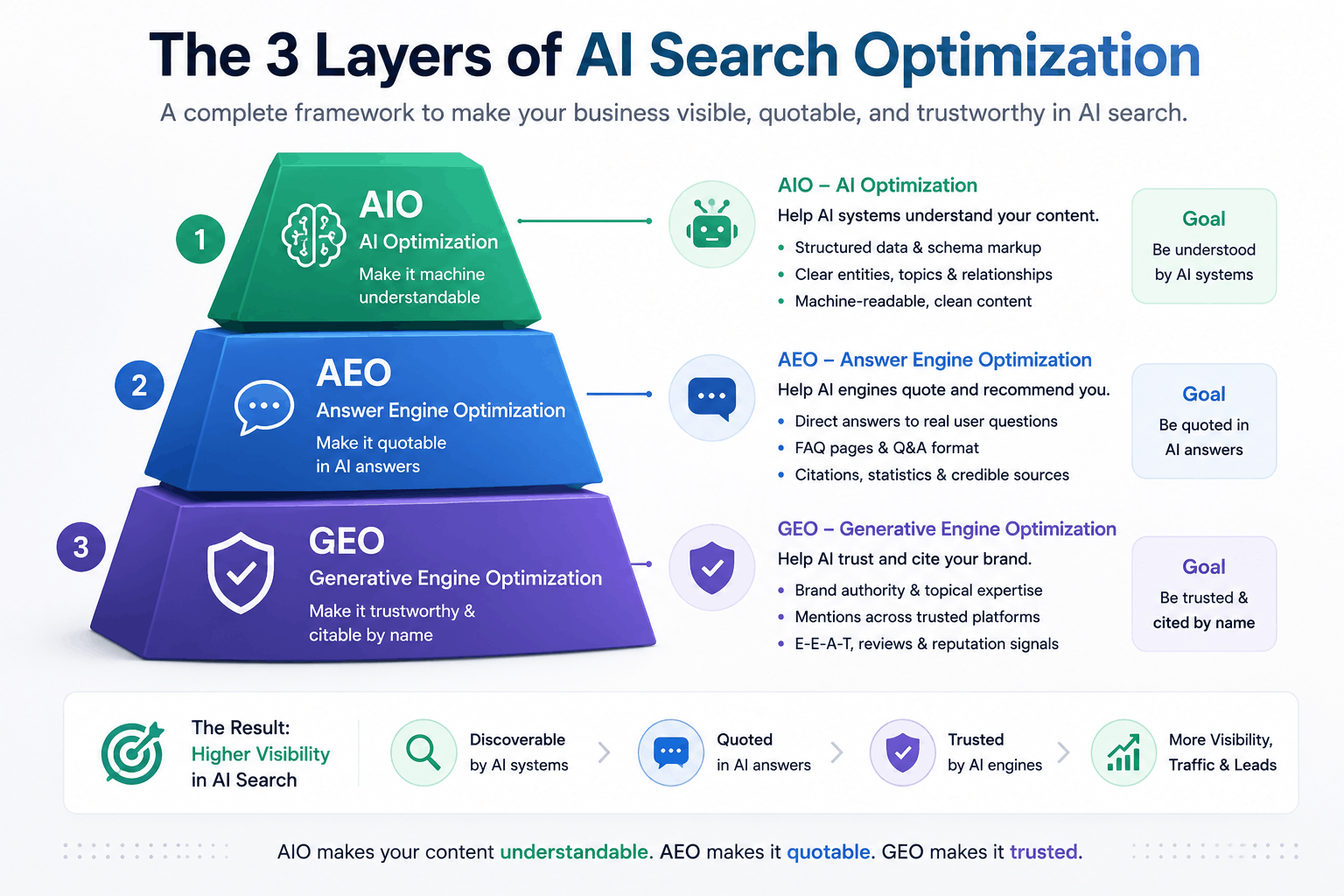
AI Search Optimization, often shortened to AI SEO, is how a business earns a place inside that answer. It isn't one technique. It's three disciplines working together:
- AIO (AI Optimization): the technical groundwork that lets AI crawlers read your site correctly.
- AEO (Answer Engine Optimization): structuring your content so it directly answers the questions people ask AI.
- GEO (Generative Engine Optimization): earning the outside trust signals, like reviews and citations, that convince AI to recommend you by name.
Together, these three layers decide whether an AI engine even knows your business exists, has something specific to say about it, and trusts it enough to mention it in an answer.
Why AI Search Optimization Matters Right Now
This isn't a future trend. It has already changed how most people search.
Google's AI Overviews now appear on roughly 43 to 48 percent of search queries, up sharply from under 15 percent a year earlier, according to tracking from Similarweb's 2026 Generative AI Landscape report and BrightEdge's industry tracking data. For certain query types, especially comparisons, questions, and "near me" searches, that share climbs even higher.
The effect on clicks is real too. Seer Interactive's research found organic click-through rates fell as much as 61 percent on queries where an AI Overview appeared. But there's an important flip side: businesses actually cited inside these AI answers earn roughly 120 percent more organic clicks per impression than uncited competitors on the same query, according to the same 2026 Seer Interactive analysis.
In short, being invisible in AI search isn't a small loss anymore, and being cited isn't a minor bonus either. It's the difference between a growing share of customers who never see your business, and customers who click through specifically because AI vouched for you.
The Three Layers of AI Search Optimization
AIO: AI Optimization (The Foundation)
AIO is the technical layer. Before an AI engine can recommend you, it has to be able to read your site cleanly. This includes:
- Schema markup that tells AI exactly what your business is, offers, and where it operates
- Clean, semantic HTML instead of bloated page-builder code
- Consistent business information, including name, address, and phone, across your website and directories
- Fast, crawlable pages
Without AIO, an AI engine may know your website exists, but it has no confident way to understand what you actually do.
AEO: Answer Engine Optimization (The Content Layer)
AEO is about content shape, not content topic. It's the difference between writing a persuasive paragraph and writing a direct answer.
AI engines don't read a page the way a person browsing a shop window would. They scan for a clear, factual answer to a specific question, then lift it into their response. AEO means:
- Answering the actual question in the first one or two sentences
- Using clear headings that match how people phrase questions
- Adding FAQ and HowTo content that mirrors real search queries
- Backing claims with specific, checkable facts instead of vague marketing language
A page that buries its answer under three paragraphs of brand story gives AI nothing to quote, so it quotes a competitor instead.
GEO: Generative Engine Optimization (The Trust Layer)
GEO is the newest and most misunderstood layer. Even a technically perfect, well-written page still needs outside proof that it's trustworthy. AI engines lean heavily on:
- Review volume, recency, and sentiment
- Mentions and citations on other authoritative sites
- Consistent information across multiple platforms
- General brand reputation signals across the web
Think of GEO as the AI-era version of backlinks and word-of-mouth combined. It isn't something you write once. It's something you build over time.
AI Search Optimization vs Traditional SEO
| Traditional SEO | AI Search Optimization |
|---|---|
| Goal: rank in the top 10 blue links | Goal: be the answer AI cites or recommends |
| Primary signal: keywords and backlinks | Primary signal: structured data, direct answers, trust |
| Content style: persuasive, long-form | Content style: question-first, factual, extractable |
| Measured by: Google rankings | Measured by: rankings plus AI citation frequency |
| Best outcome: a click | Best outcome: a direct recommendation, sometimes with no click at all |
They aren't competitors. Good AI Search Optimization strengthens traditional SEO too, but strong SEO alone no longer guarantees AI visibility.
How AI Engines Actually Decide Who to Recommend
Every major AI engine, including ChatGPT, Gemini, Perplexity, and Copilot, works roughly the same way when answering a "who should I use" or "what's the best" question:
- It identifies the entity, meaning your business, that it already recognizes.
- It checks whether it has specific, factual content that answers the question.
- It weighs how trustworthy that content and business appear, based on outside signals.
- It generates an answer, naming the sources it trusts most.
Miss any one of those steps, and a competitor gets named instead, even if your business is objectively better.
A Simple Example: How This Plays Out in Search
Picture two HVAC companies in the same city. Both have decent websites and a handful of good reviews. A homeowner asks ChatGPT, "who's a reliable HVAC company near me for an AC repair this week?"
Company A has a website written entirely in marketing language: "We're the trusted name in comfort since 1998." No schema markup. No FAQ page. Reviews are scattered across three different platforms with inconsistent business names.
Company B has LocalBusiness and Service schema in place, an FAQ page that directly answers "how fast can you fix an AC unit," and consistent business details across its website, Google Business Profile, and directories.
AI has almost nothing concrete to work with for Company A. For Company B, it has a specific, checkable answer to lift straight into its response. All else being roughly equal, Company B gets named. Company A doesn't, even if its actual service is just as good.
That gap isn't about who's better at HVAC. It's entirely about who structured their information so AI could use it.
Common Mistakes That Keep Businesses Invisible
- No schema markup, so AI has to guess what the business does
- Content written to persuade, not to answer, so there's nothing quotable
- Inconsistent business details across the website, directories, and social profiles
- No FAQ content built around real customer questions
- Ignoring reviews as a ranking and trust signal
- Never checking what AI engines are actually saying about the business today
How to Get Started: A Simple 5-Step Checklist
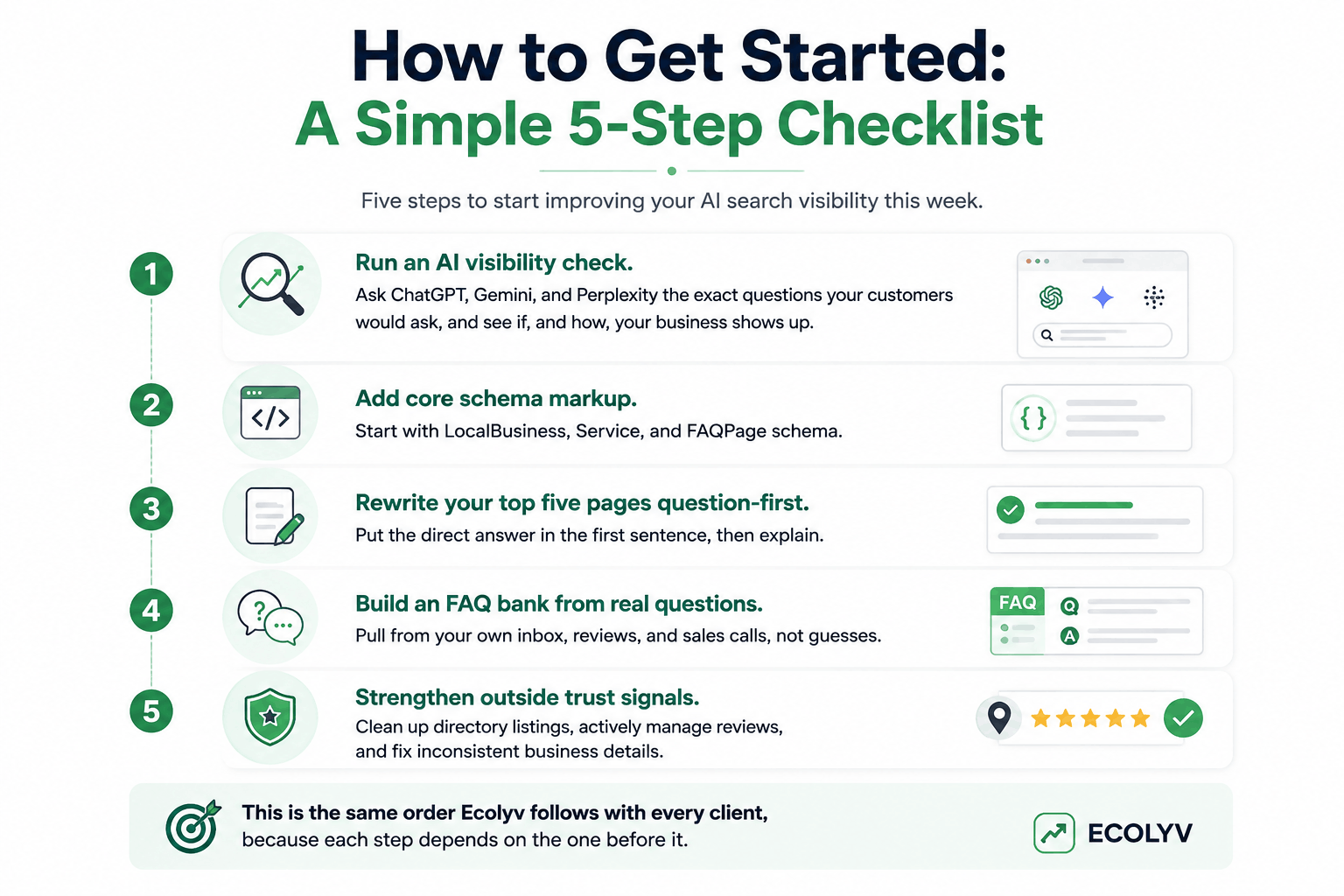
- Run an AI visibility check. Ask ChatGPT, Gemini, and Perplexity the exact questions your customers would ask, and see if, and how, your business shows up.
- Add core schema markup. Start with LocalBusiness, Service, and FAQPage schema.
- Rewrite your top five pages question-first. Put the direct answer in the first sentence, then explain.
- Build an FAQ bank from real questions. Pull from your own inbox, reviews, and sales calls, not guesses.
- Strengthen outside trust signals. Clean up directory listings, actively manage reviews, and fix inconsistent business details.
This is the same order Ecolyv follows with every client, because each step depends on the one before it.
Who Needs This Most
Any business whose customers research before they buy benefits from AI Search Optimization. That includes dentists, law firms, HVAC and plumbing companies, roofers, electricians, healthcare providers, SaaS companies, and marketing agencies, essentially anywhere trust and comparison shopping happen before the first phone call.
How This Connects to Your Google Business Profile and Website
AI Search Optimization isn't a standalone project. It pulls directly from two other places most businesses already have room to improve:
- Your Google Business Profile is one of the biggest GEO trust signals AI engines check for local queries, since it's a live, frequently updated source of reviews, categories, and business details.
- Your website's underlying code, covered in AI-ready website design, determines whether AIO's technical layer can even function in the first place.
- Your FAQ and answer-style content, the focus of Answer Engine Optimization, is what gives AEO something specific to quote.
Treat these as three legs of the same table. Strengthening only one leaves the others wobbling.
FAQs
What does AI Search Optimization mean?
It's the process of structuring a business's website, data, and online presence so AI engines like ChatGPT, Gemini, and Google AI Overviews can find, understand, and recommend it. It combines technical setup (AIO), answer-ready content (AEO), and outside trust signals (GEO) into one strategy.
Is AI Search Optimization the same as SEO?
No. Traditional SEO focuses on ranking in search results. AI Search Optimization focuses on being the source an AI engine quotes or recommends directly, often without a click at all. The two work together, but AI search optimization requires signals traditional SEO doesn't typically address.
What's the difference between AIO, AEO, and GEO?
AIO makes your content machine-readable. AEO structures it so AI can lift a direct answer from it. GEO earns the outside citations and trust signals that convince AI to recommend you over a competitor. All three work together, not separately.
How long does AI Search Optimization take to show results?
Most businesses see early movement, like featured snippets and AI Overview appearances, within 6 to 10 weeks. Broader, consistent AI citation growth across engines usually takes 3 to 6 months, since trust signals build gradually rather than overnight.
Can I do AI Search Optimization myself?
Yes, in part. Adding schema markup, rewriting pages question-first, and building an FAQ bank from real customer questions are all things a business owner can do without an agency. Building consistent, wide-scale trust signals is harder to do alone and usually benefits from dedicated support.
Which AI engines should I optimize for?
The major ones customers actually use are Google AI Overviews, ChatGPT, Gemini, Perplexity, and Microsoft Copilot. Most AI Search Optimization work, including schema and structured content, improves visibility across all of them at once, rather than requiring a separate strategy for each platform.
Does Google Business Profile matter for AI search?
Yes, especially for local businesses. AI engines lean heavily on Google Business Profile data, including categories, reviews, hours, and Q&A, when answering local "near me" questions. An incomplete or inconsistent profile is one of the most common reasons local businesses stay invisible in AI answers.
How do I know if AI is already recommending my business?
Ask ChatGPT, Gemini, and Perplexity the exact questions your customers would type, using your city and service. If your business doesn't appear, or a competitor is named instead, that's a direct signal of where your AI Search Optimization needs to start.
Key Takeaways
- AI Search Optimization is the strategy of getting found, understood, and recommended by AI engines, not just ranked by Google.
- It works through three layers: AIO (technical readability), AEO (answer-ready content), and GEO (outside trust signals).
- AI Overviews already appear on roughly half of Google searches, and that share keeps growing.
- Businesses cited inside AI answers tend to see stronger click and enquiry performance than those left out.
- Getting started doesn't require a full rebuild. An AI visibility check, core schema, and question-first content cover the first real steps.
About the Author
Hitesh Chauhan is the founder of Ecolyv and has spent 5+ years working across IT, SaaS, and cybersecurity content, helping businesses get found through Google Business Profile optimization and, more recently, AI search visibility. He writes Ecolyv's AI Search Optimization guides based on what's actually working for clients, not general theory.
Want to see exactly where your business stands in ChatGPT, Gemini, and Google AI Overviews today?
Book a free 30-minute AI Visibility Strategy Call with Ecolyv. No pitch, just a clear look at your current AI visibility and what it would take to improve it.
Get Your Free AI Visibility Check See Pricing