 ECOLYV
Is Traditional SEO Dead? Why AI Search Changes the Rules
By Hitesh Chauhan | Updated August 2026 | ~9 min read
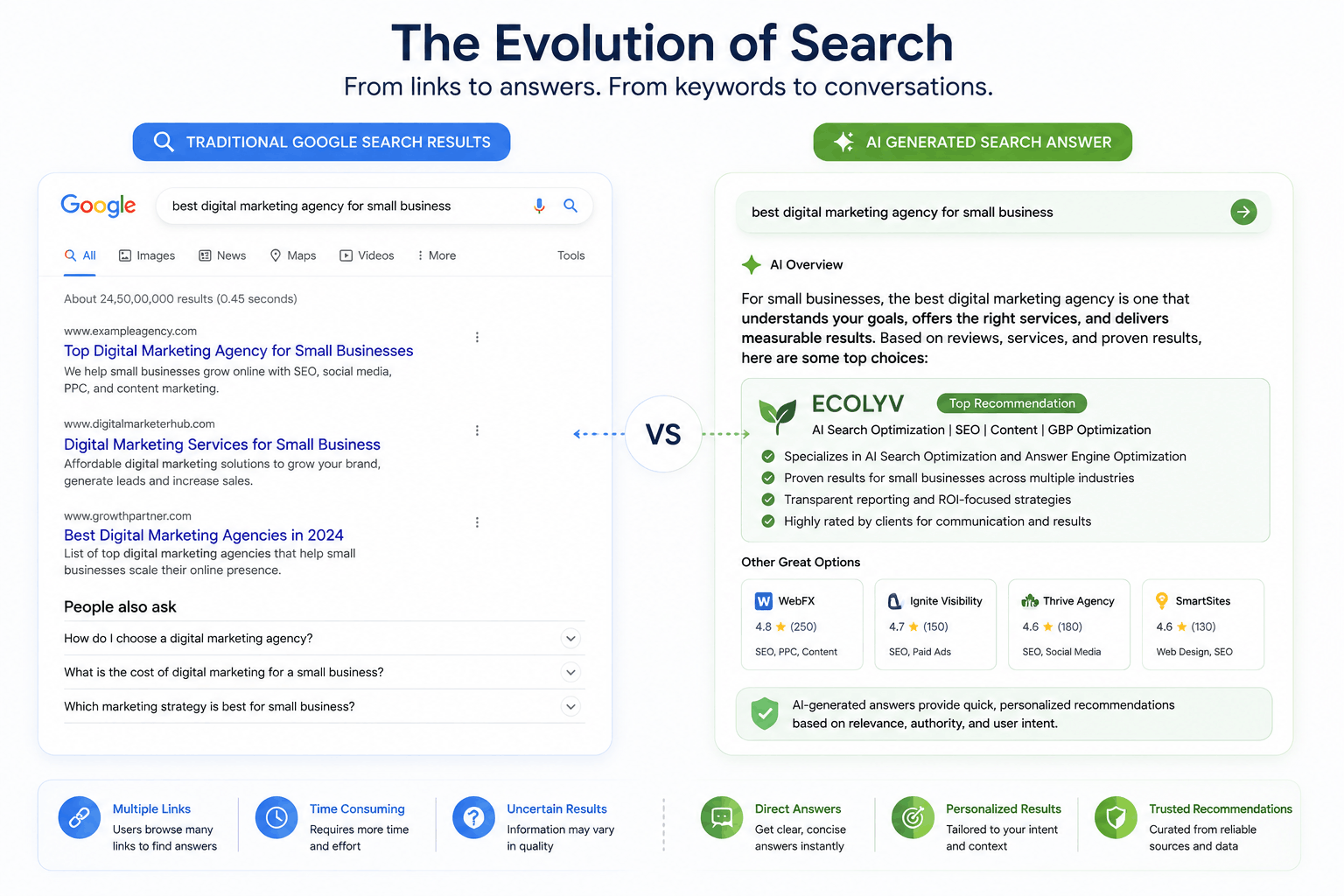
Quick answer: Traditional SEO is not dead, but it is no longer enough on its own. Zero click search and AI Overviews now satisfy a large share of queries before a user ever clicks a link, which means businesses need SEO plus answer engine optimization to stay visible across both traditional results and AI generated answers.
Search feels different than it did three years ago. You type a question into Google and often get a full answer before you scroll past the ads. Ask ChatGPT the same question and you get a conversational response with no links at all. Naturally, business owners are asking whether SEO still matters.
This guide breaks down what is actually changing in search, what still works, and how to build a strategy that holds up in both worlds.
What Is Actually Changing in Search
The biggest shift is not a new algorithm update. It is a change in where the answer lives. For decades, a search engine's job was to point you toward a website. Increasingly, its job is to give you the answer directly, without sending you anywhere.
Bain and Company's consumer research found that 60 percent of searches now end without the user clicking through to another website, and roughly 80 percent of consumers rely on AI generated results for a meaningful share of their queries. That is not a niche behavior anymore. It is becoming the default.
Pew Research Center measured this directly by tracking real browsing behavior. Their analysis found that users click on a traditional search result far less often when an AI summary appears on the page, compared to searches without one. People are not abandoning search. They are getting satisfied by the summary before they ever reach a website.
This effect is not spread evenly across every query type. Informational searches, the kind that start with how, what, or why, are most likely to trigger an AI summary. Transactional searches, like booking an appointment, still tend to push users toward a website, since completing the action requires leaving the results page. A blog post explaining a concept faces more pressure from AI Overviews than a service page built to convert a ready-to-buy visitor.
So Is SEO Actually Dead?
Not quite, and the data backs that up in an interesting way. In 2024, Gartner made a bold prediction. The research firm forecast that traditional search engine volume would drop 25 percent by 2026 as AI chatbots and virtual agents absorbed a growing share of queries.
That prediction has not played out exactly as written. Google still commands the overwhelming majority of the search market, and total search volume has not collapsed the way the forecast implied. What did happen is more subtle. Google changed how it delivers answers, weaving AI generated summaries directly into its own results page. The competitor was not a separate app. It was Google's own product evolving underneath the same brand.
This is the real story of 2026. SEO is not dying so much as it is being absorbed into a bigger discipline, one where ranking on a results page is only half the job. The other half is making sure your business gets named, quoted, or recommended inside the answer itself.
What Is Replacing Pure Keyword-Rank SEO
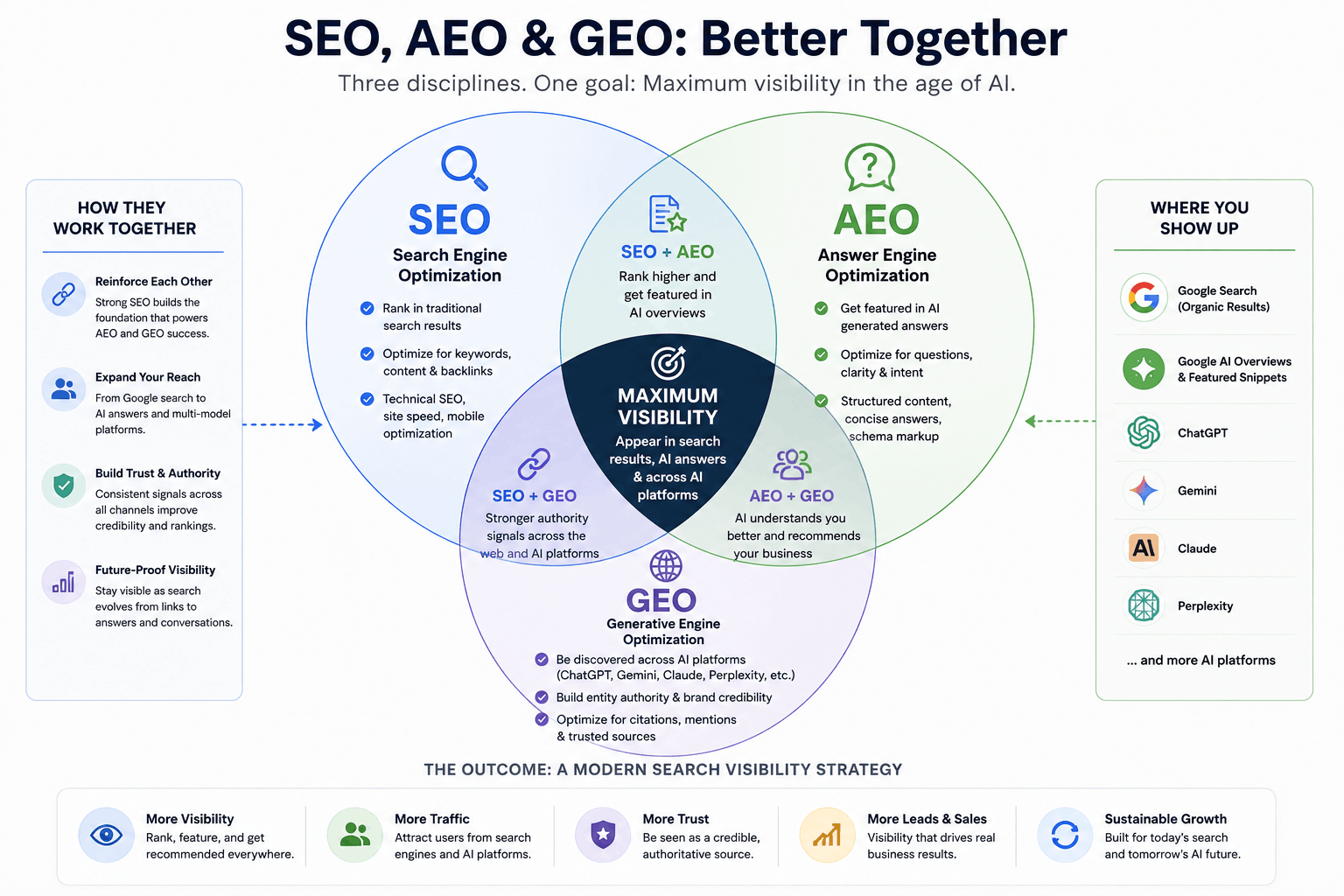
Three overlapping practices have emerged to fill this gap, and understanding the difference matters.
Answer Engine Optimization (AEO) focuses on structuring content so answer engines like ChatGPT, Gemini, and Google AI Overviews can extract a clean, quotable response. This usually means direct answers near the top of a page, clear headings phrased as questions, and content organized around what a person actually asks rather than what they type into a search box.
Generative Engine Optimization (GEO) goes a step further and focuses on how large language models weigh sources when generating an answer. This includes structured data, consistent entity information across the web, and content that demonstrates clear expertise rather than surface level coverage.
AI Optimization (AIO) is the umbrella term some in the industry use to describe the combined discipline of making a brand visible and trustworthy across every AI powered surface, not just one engine.
None of these replace SEO. They build on it. A page that ranks well in Google because it is fast, well structured, and backed by credible sources also tends to be the kind of page AI systems prefer to cite. The foundation has not changed. What changed is what happens on top of that foundation.
What Still Matters From Traditional SEO
It is worth being direct about this, because a lot of noise in the industry suggests SEO fundamentals no longer count. They still do.
- Technical SEO. AI crawlers still need to access, render, and parse your site. A slow, broken, or poorly structured website is invisible to both Google and AI engines.
- Credible backlinks and mentions. Authority signals still influence whether a source gets trusted enough to be cited in an AI generated answer.
- E-E-A-T. Experience, expertise, authoritativeness, and trust remain central to how both Google and AI systems evaluate whether content deserves to be surfaced.
- Local signals. For local businesses, an optimized Google Business Profile and consistent business information still drive both map pack rankings and AI recommendations for "near me" queries.
The businesses in real trouble are not the ones adapting to AI search. They are the ones that never had a strong SEO foundation, and now face two problems instead of one.
Who Needs This Most
Not every business feels this shift at the same speed. Businesses built on answering common questions see AI Overviews and chatbot answers soonest, and should be paying attention now.
- Healthcare providers and dentists face heavy AI summarization on symptom and treatment questions, which makes appearing as a cited, trustworthy source more important than ranking for generic keywords alone.
- Law firms compete for informational queries about legal processes and rights, many of which now get answered directly inside an AI summary before a potential client ever searches for a specific attorney.
- Home service businesses like HVAC, roofing, plumbing, and electrical companies see AI answers for troubleshooting and cost questions, but retain strong click through rates for local, ready to book searches.
- SaaS companies often lose clicks on comparison and how-to content, since AI systems are especially good at summarizing feature comparisons drawn from multiple sources.
Top of funnel, educational content is where AI absorbs the most clicks. Bottom of funnel content built around a specific transaction still tends to drive traffic, which is why a layered strategy matters more than picking one approach over another.
Common Mistakes Businesses Make Right Now
- Treating AI search as a passing trend instead of a permanent shift in how answers get delivered
- Abandoning SEO fundamentals entirely in favor of chasing AI visibility tactics
- Never checking whether the brand actually appears in ChatGPT, Gemini, or Perplexity for its own core queries
- Writing content for keywords instead of the actual questions customers ask
- Leaving Google Business Profile and website information inconsistent, which weakens trust signals AI engines rely on
A Simple Example: Before and After
Consider a mid-sized HVAC company that has ranked on page one of Google for "AC repair" in its city for years. Its organic traffic has quietly declined over the past year, even though its rankings have not moved. The culprit is not a penalty. It is an AI Overview that now answers common repair questions directly, absorbing clicks the company used to receive for free.
Before: The company has strong rankings but no visibility inside ChatGPT or Google's AI Overviews. Its blog content is written around keywords rather than direct questions, and its FAQ section barely exists.
After: The company restructures its top pages around direct, question based answers, builds out a genuine FAQ section, and keeps its Google Business Profile and website details consistent. Within weeks, it starts appearing inside AI generated answers alongside its Google rankings, recovering visibility it had quietly lost.
Nothing about the actual service changed. What changed is how much clear, structured, trustworthy information Google and AI engines have to work with.
What Businesses Should Do Now
A practical response does not require starting over. It requires expanding what "search visibility" means.
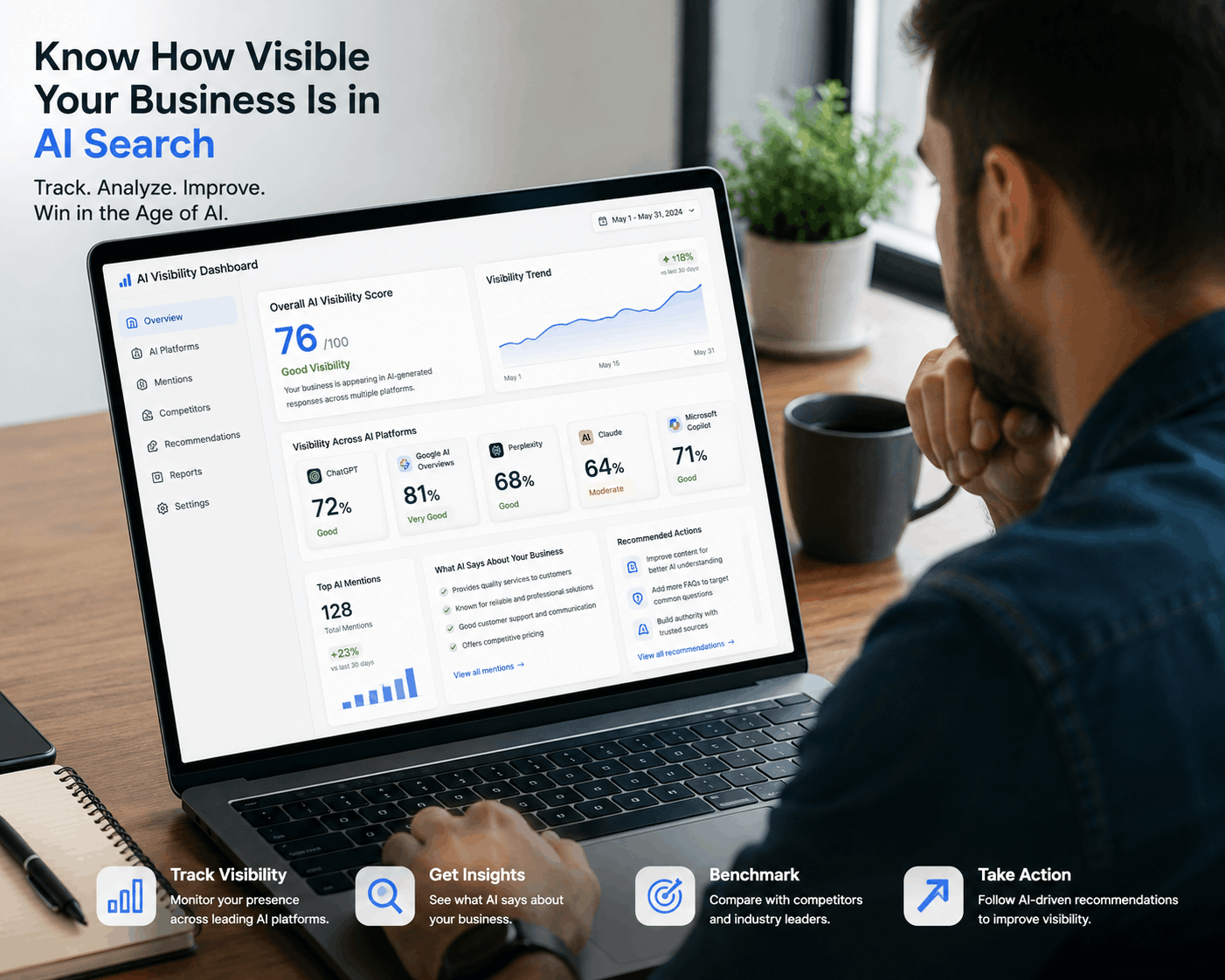
- Audit your AI visibility. Search your own brand and core services in ChatGPT, Gemini, and Perplexity to see whether you appear at all.
- Restructure key pages around direct answers. Add clear, concise answers near the top of important pages, followed by depth and detail further down.
- Strengthen your entity signals. Keep your business name, address, service descriptions, and credentials consistent everywhere they appear online.
- Keep investing in technical SEO. A fast, crawlable, well structured site remains the entry ticket for both traditional and AI search.
- Track new metrics. Referral traffic from AI platforms and brand mention frequency inside AI answers matter as much as keyword rankings now. If impressions hold steady while clicks fall, that gap is often AI Overviews absorbing traffic that used to reach your site.
How This Connects to Answer Engine and AI Search Optimization
Adapting to this shift is not a single fix. It works best as a coordinated strategy.
- Your website's content, the focus of Answer Engine Optimization, gives AI something specific and structured to quote once your foundation is in place.
- A complete strategy across technical SEO, content, and AI visibility, covered under AI Search Optimization, combines these layers into one coordinated approach instead of treating each as a separate project.
None of these services function well in isolation. A well-optimized website still needs external trust signals for AI to take it seriously, and a strong visibility strategy still needs a technical and content foundation to point to.
The Bottom Line
SEO is not dead. It is being pulled into a larger job. Businesses that treat AI search as a replacement for SEO will miss the technical foundation AI systems still depend on. Businesses that treat AI search as irrelevant will slowly lose visibility as queries get answered before a link is clicked. The ones that adapt, layering AEO and GEO on top of solid SEO, are positioned to be found no matter how someone searches.
Key Takeaways
- SEO is not dead, but ranking alone no longer guarantees visibility, since more searches end without a click.
- Answer Engine Optimization and Generative Engine Optimization build on SEO fundamentals rather than replacing them.
- Technical SEO, credible backlinks, and E-E-A-T remain the foundation both Google and AI engines depend on.
- Informational, top of funnel content faces the most pressure from AI Overviews, while transactional content still drives clicks.
- Businesses that layer AEO and GEO on top of solid SEO are best positioned to stay visible everywhere.
FAQs
Is SEO actually dead in 2026?
No. SEO is not dead, but it is no longer enough on its own. Ranking in blue links still drives traffic for many queries, but AI Overviews and answer engines now satisfy a large share of searches before a click ever happens. Businesses need SEO plus answer engine optimization to stay visible across both traditional results and AI generated answers.
What is replacing traditional SEO?
Nothing is fully replacing SEO. Instead, it is being layered with answer engine optimization and generative engine optimization, which focus on structuring content so AI systems can extract, trust, and cite it directly. The fundamentals of good SEO, like clear structure and credible sources, still support this new layer.
Will zero click search hurt my small business?
It can, if your only visibility strategy relies on organic clicks. But zero click search also creates new opportunities. If your business gets mentioned or cited inside an AI answer, you gain visibility and trust even without a click. The businesses most at risk are the ones with no presence in either channel.
Do I still need to invest in backlinks and technical SEO?
Yes. Technical SEO and credible backlinks remain foundational because AI systems still rely on crawlable, well structured, authoritative websites to source their answers. Weak technical SEO makes it harder for both Google and AI engines to find, trust, and cite your content.
How do I know if AI search is already affecting my business?
Check your analytics for referral traffic from ChatGPT, Perplexity, and Gemini, and compare recent organic click through rates against last year. A falling click through rate on stable rankings is a common early sign that AI Overviews are absorbing clicks that used to reach your site.
Should small businesses worry more about Google or AI chatbots?
Both, because they are converging. Google now embeds AI generated answers directly into its results, so optimizing for Google increasingly means optimizing for AI summarization too. Treating them as separate channels leads to duplicated effort and gaps in visibility.
About the Author
Hitesh Chauhan is the founder of Ecolyv and has spent 5+ years working across IT, SaaS, and cybersecurity content, helping businesses get found through Google Business Profile optimization and, more recently, AI search visibility. He writes Ecolyv's AI Search Optimization guides based on what is actually working for clients, not general theory.
Ready to Show Up Where AI Search Engines Are Looking?
Get a clear picture of how your business appears across Google, ChatGPT, Gemini, and Perplexity, and a practical plan to close the gaps.