 ECOLYV
FAQ & HowTo Schema Markup: A Step-by-Step Setup Guide
By Hitesh Chauhan | Updated August 2026 | ~9 min read
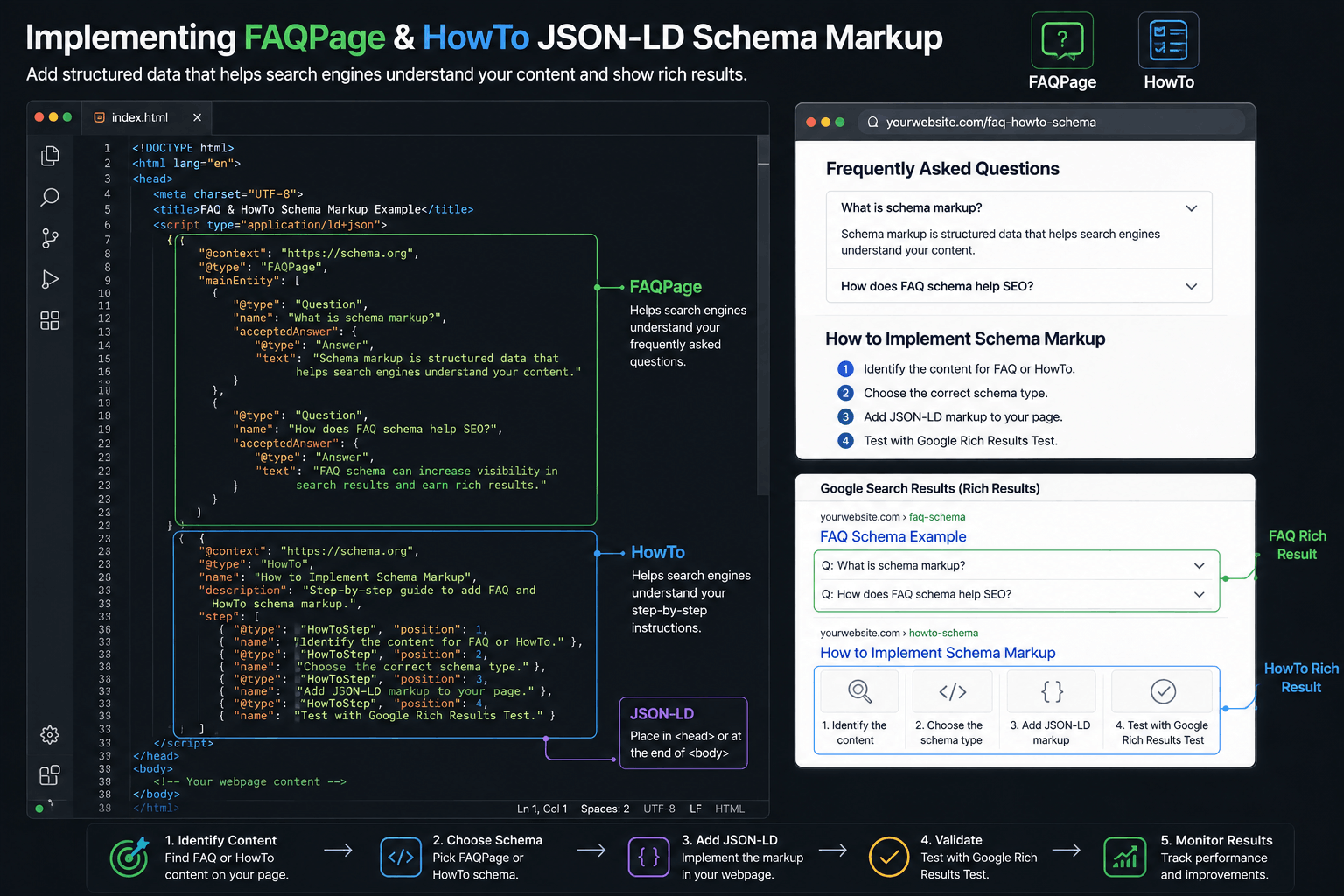
Quick answer: To implement FAQ and HowTo schema, write the JSON-LD in a script tag with type application/ld+json, placed in the page head, mirroring your visible content exactly. FAQPage uses Question and acceptedAnswer properties for each pair. HowTo uses ordered HowToStep objects. Validate both with validator.schema.org before publishing, and keep the markup in sync whenever the visible content changes.
Schema markup looks intimidating the first time you open a JSON-LD example, but the actual structure is simple once you see it laid out step by step. This guide walks through exactly how to implement FAQPage and HowTo schema, with copy-paste code you can adapt directly, along with what has actually changed about how Google and AI systems use this markup in 2026.
Most of the confusion around schema comes from outdated advice still circulating from a few years ago, when a rich snippet was the main reward for adding it. That reward has changed, but the underlying mechanics of writing valid JSON-LD have not, which is why this guide focuses on the practical setup rather than chasing a search feature that no longer exists.
Important Context: What Changed With FAQ Rich Results
Before implementing anything, it is worth knowing what schema markup can and cannot do in 2026. Google's own documentation update confirms that FAQ rich results no longer appear in Google Search as of May 7, 2026, with related Search Console reporting removed in June and API support ending in August. The expandable question-and-answer dropdown that used to appear directly in search results is gone.
This does not mean FAQ schema lost its value. It means the value moved. The visual SERP feature is retired, but FAQPage markup remains valid and continues to help AI systems parse and extract question-and-answer content cleanly. The reason to implement schema in 2026 has shifted from earning a rich snippet to earning an AI citation.
It is also worth being precise about what schema does and does not guarantee. Google's current public guidance states that no special schema.org markup is required for AI Overviews or AI Mode, and independent research reported by Foglift found that a December 2024 study found no statistically meaningful correlation between schema markup coverage and LLM citation frequency on its own. Schema should be treated as explicit page classification that helps machines parse content correctly, not as a citation guarantee by itself.
Why Schema Still Matters for AI Search
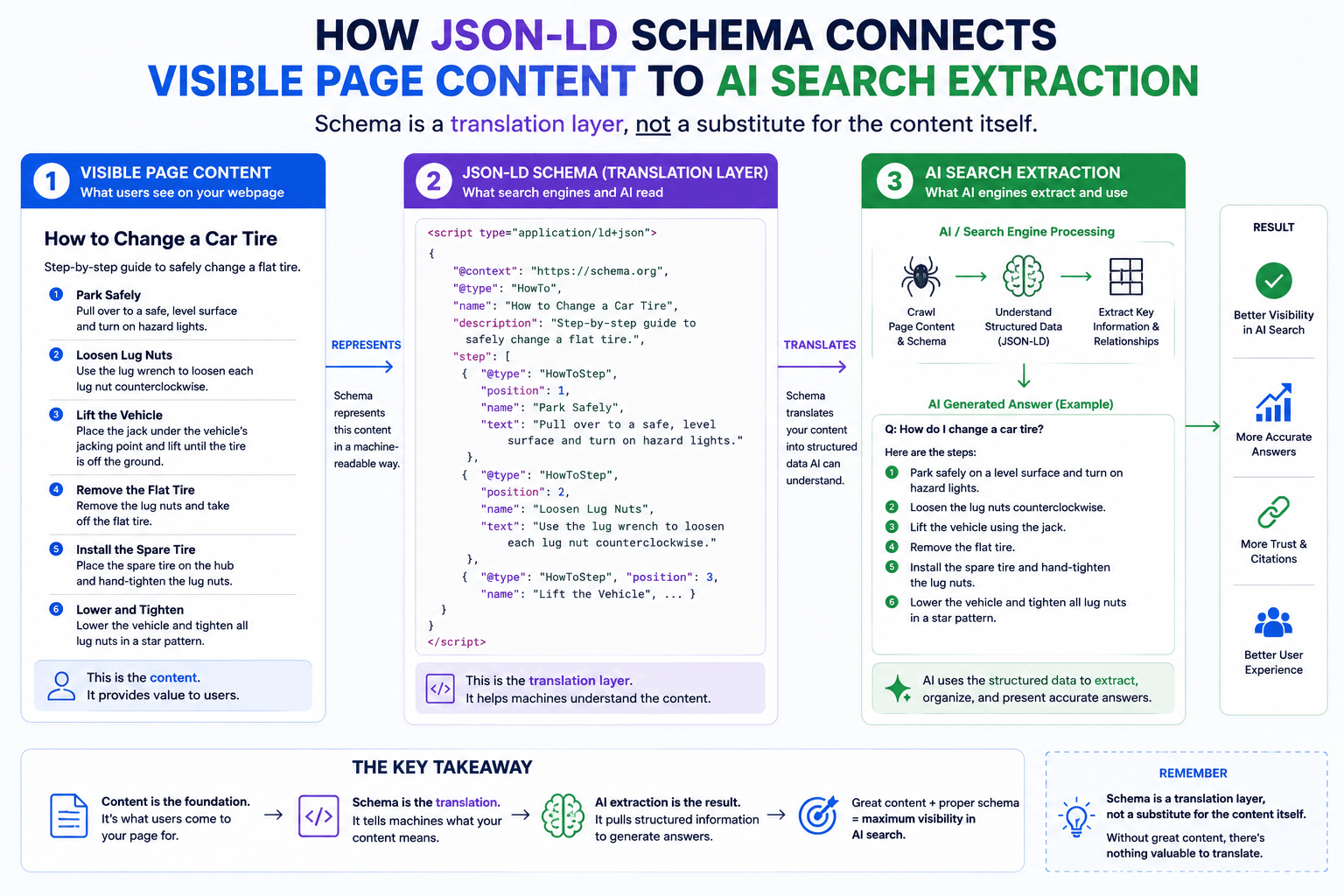
Structured data gives AI systems an explicit, machine-readable version of information that already exists on the page in plain text. It does not replace good content, and it cannot rescue a thin or poorly written page. What it does is remove ambiguity, making it easier for a model to confirm exactly which text answers which question, or exactly what order a set of steps happens in.
This matters most when paired with genuinely well-structured visible content. Schema layered over vague or generic answers adds little, since AI systems still need something specific and accurate to extract and cite in the first place. Treat schema as a supporting layer that reinforces content quality, not as a shortcut that substitutes for it.
There is also a practical maintenance argument for keeping schema clean regardless of any citation debate. A well-structured JSON-LD block makes a page easier to audit, easier to hand off between team members, and easier to update consistently as content changes, which has value independent of any single search feature.
Step 1: FAQPage Schema, Copy-Paste Template
Use FAQPage for a set of standalone questions with fixed, official answers. Each question and answer pair goes inside the mainEntity array, exactly matching the visible text on the page. This distinction matters: FAQPage is meant for content the business controls and stands behind, not for open, user-submitted questions, which fall under a different schema type called QAPage.
Repeat the Question and Answer block for every FAQ pair on the page. There is no limit on how many pairs you can include, but 8 to 12 well-written pairs is generally the most useful range, since too few looks thin and too many can dilute focus.
Step 2: HowTo Schema, Copy-Paste Template
Use HowTo when a page describes an ordered, step-by-step process rather than standalone questions. Each step becomes a HowToStep object listed in the order it should be performed. Unlike FAQPage, sequence matters here, since the schema is meant to represent an actual procedure a reader or an AI system could follow in order.
Keep each step name short and the text field detailed enough to actually complete the step without needing to consult the surrounding page content. Optional properties like totalTime and image can be added per step if that detail genuinely exists on the page, but never add a property that has no visible counterpart.
Step 3: Where to Place the Code
Both scripts belong in the head section of the page, though placement just before the closing body tag also works technically. What matters more than exact placement is that the content inside the script tag stays valid JSON, with no trailing commas or unescaped quotation marks, since a single syntax error can invalidate the entire block.
Most content management systems and website builders offer a dedicated field for custom head scripts, which is usually the cleanest place to add this code without touching a page's core template files directly.
Step 4: Validate Before Publishing
Never publish schema without checking it first. Paste the code into validator.schema.org to confirm it is syntactically valid, then run the live page through Google's Rich Results Test to confirm Google can parse it correctly, even though FAQ rich results themselves are retired. Both tools are free and take under a minute per page.
Make validation a standing part of your publishing checklist rather than a one-time step. Any time content on the page changes, the schema needs a quick re-check to confirm it still reflects what is actually visible.
Common Mistakes to Avoid
Most invalid or ineffective schema implementations trace back to one of these five issues.
- Marking up questions or steps that are not actually visible on the page
- Letting the schema text drift out of sync after editing the visible content
- Using FAQPage for a step-by-step process instead of HowTo, or the reverse
- Leaving trailing commas or broken quotation marks that invalidate the JSON
- Assuming schema alone will earn a citation without well-written visible content behind it
Who Needs This Most
Any business publishing FAQ pages, support documentation, or step-by-step guides benefits from proper schema implementation, particularly SaaS companies with help centers, consultants with process-heavy service pages, and any business whose content already answers real customer questions but has never been marked up. Businesses migrating from older FAQ schema implementations built purely for rich results also benefit from revisiting their markup now, since the reasoning behind it has fundamentally changed.
How This Connects to Answer Engine Optimization
Schema is the technical layer of a broader AEO strategy, not a standalone fix.
- Our guide on Answer Engine Optimization covers how to write the underlying content this schema is built to represent.
- Our full AI Search Optimization service implements and validates schema across a site as part of a coordinated technical and content program.
Schema without strong visible content behind it accomplishes very little. The two need to be built together.
Key Takeaways
- Google retired FAQ rich results in May 2026, but FAQPage schema remains valid and still helps AI systems parse content.
- Use FAQPage for standalone questions and HowTo for ordered, step-by-step processes.
- Schema must mirror visible on-page content exactly, with no invented or hidden text.
- Always validate JSON-LD with validator.schema.org before publishing.
- Schema is a technical translation layer, not a substitute for genuinely well-written content.
FAQs
Is FAQ schema still worth implementing after Google retired FAQ rich results?
Yes. FAQPage schema no longer produces the expandable dropdown in Google Search, but it remains valid markup that helps AI systems like ChatGPT and Perplexity parse and extract question and answer content cleanly. The value shifted from search appearance to AI citation.
Do I need a developer to add FAQ or HowTo schema?
Not necessarily. JSON-LD is plain text that can be added directly into a page's head section, and many website platforms and plugins support it without custom development. Copying a validated template and adjusting the content is often enough for a straightforward page.
What happens if my schema does not match my visible content?
A mismatch between schema and visible content violates Google's structured data guidelines and can cause search engines and AI systems to distrust or ignore the markup entirely. Keeping the two in exact sync is one of the most important rules in schema implementation.
Should I use FAQPage or HowTo schema for a process page?
Use HowTo schema when a page describes an ordered, step-by-step process, and use FAQPage schema when a page answers multiple standalone questions. A page can use both if it contains distinct FAQ and step-by-step sections.
How do I check if my schema is implemented correctly?
Paste your page URL or JSON-LD code into validator.schema.org or Google's Rich Results Test. Both tools flag syntax errors and missing required properties before the markup goes live on your site.
Can I add multiple schema types to the same page?
Yes. It is common and recommended to combine Article, FAQPage, and HowTo schema on a single page when the content genuinely includes all three elements, using separate script tags for each type.
About the Author
Hitesh Chauhan is the founder of Ecolyv and has spent 5+ years working across IT, SaaS, and cybersecurity content, helping businesses get found through Google Business Profile optimization and, more recently, AI search visibility. He writes Ecolyv's AI Search Optimization guides based on what is actually working for clients, not general theory.
Want Your Schema Implemented and Validated for You?
We audit your existing pages, build clean FAQPage and HowTo schema that matches your visible content exactly, and validate everything before it goes live.