 ECOLYV
How to Write FAQ Content That Gets Cited by ChatGPT and Google AI Overviews
By Hitesh Chauhan | Updated August 2026 | ~8 min read
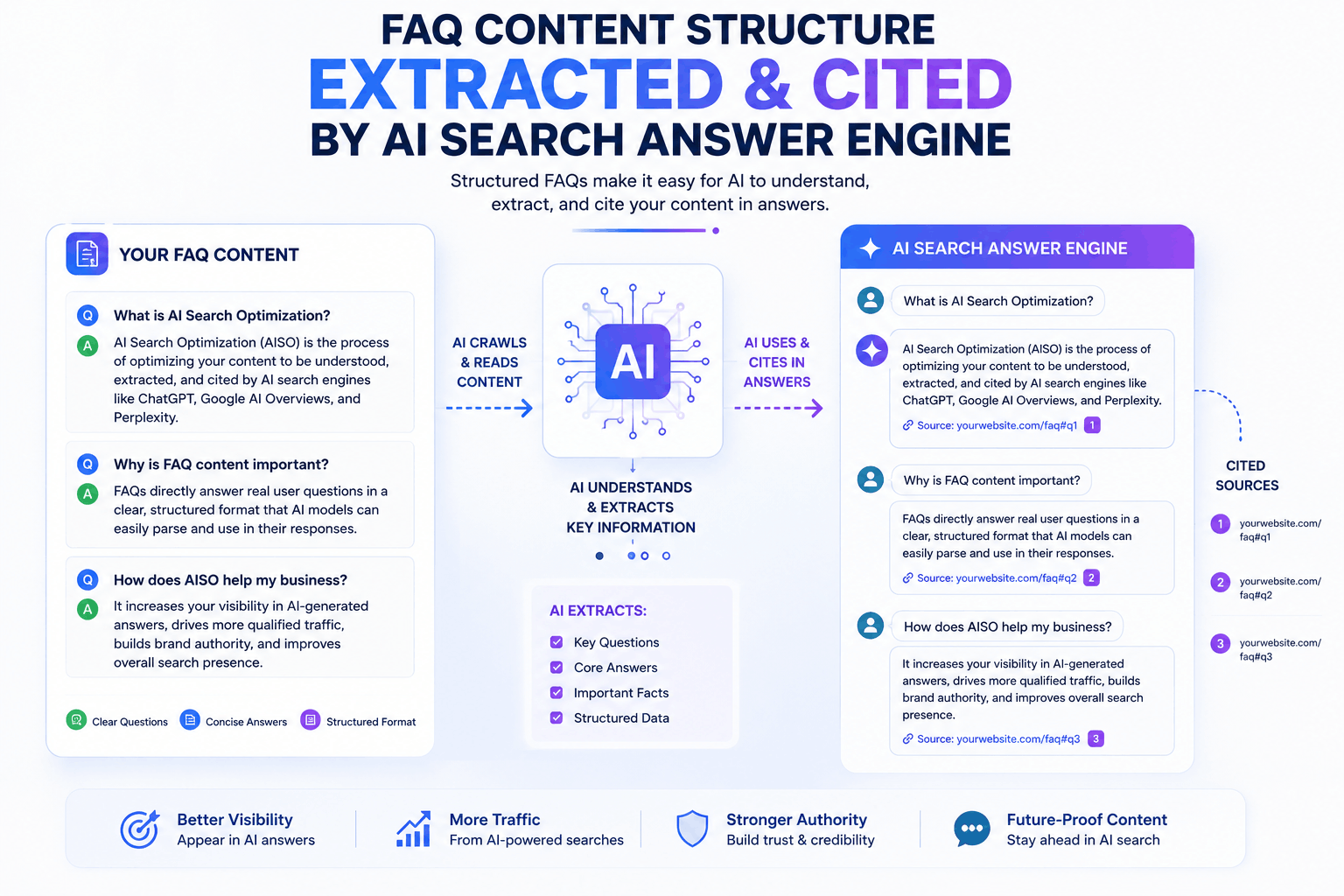
Quick answer: To write FAQ content AI systems will cite, use real questions phrased the way customers actually ask them, answer directly in the first sentence, keep each answer to 40 to 60 words, and make sure each answer makes complete sense on its own. Match the visible copy exactly with FAQPage schema, and refresh answers regularly to keep them current.
Most FAQ sections get written as an afterthought, a handful of loosely related questions bolted onto the bottom of a page. AI systems reward the opposite approach. A tightly written FAQ block, structured the right way, is one of the fastest ways to earn a citation in ChatGPT, Perplexity, or a Google AI Overview.
The reason is structural. FAQ content already comes pre-packaged as question and answer, which happens to be exactly the shape AI systems are trying to extract from the open web. Everything else on a page, from marketing copy to long-form explanation, has to be interpreted and condensed before a model can use it. A well-written FAQ answer skips that step entirely.
This guide walks through exactly how to write FAQ content that AI systems can extract cleanly and confidently attribute to your business.
Why FAQ Content Gets Cited More Than Other Formats
FAQ sections already exist in the shape AI systems are looking for. A question paired with a direct answer is a self-contained unit a model can lift and present as a complete response, without needing to summarize or restructure surrounding paragraphs.
The data backs this up clearly. Research analyzing AI citation patterns found that pages with FAQPage schema are 3.2 times more likely to appear in Google AI Overviews than pages without it, according to Frase.io's analysis of citation data. That is a significant gap for a structural change that typically takes less than an hour to implement on an existing page.
Authority still matters alongside structure. Industry data widely cited in AI search research suggests that 96 percent of pages cited in AI Overviews carry verifiable experience, expertise, authoritativeness, and trust signals. A well-written FAQ answer still needs to sit on a page backed by real credibility, not float on its own.
This also explains why FAQ content travels so well across platforms. AI engines pull citations from many sources but rarely overlap in exactly which page they choose, so a cleanly structured FAQ answer can earn a pick in an AI Overview snippet, a ChatGPT response, and a Perplexity card without needing separate versions written for each one.
The Anatomy of a Citable FAQ Answer
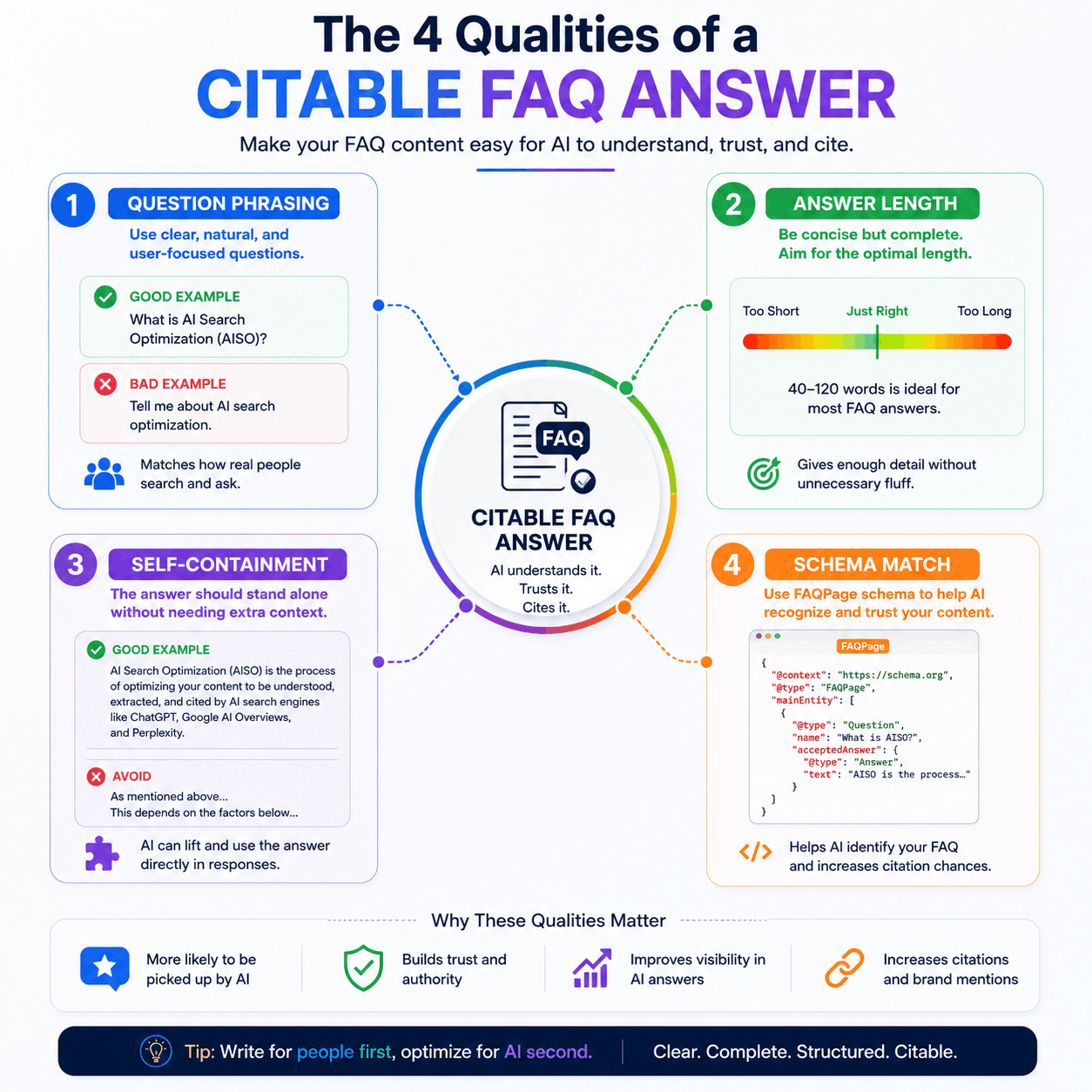
Four specific qualities separate an FAQ answer that gets cited from one that gets skipped. Getting three out of four right is not enough. Each one independently affects whether a model chooses to extract the answer at all.
Question phrasing. Write the question the way a real person would type or ask it aloud, not as an internal label. "How much does a GBP audit cost" earns matches a phrase like "GBP audit pricing overview" never will. Keep questions specific and singular, since one question should ask one thing, which keeps the matching answer focused and self-contained.
Answer length. Two to four sentences, in the 40 to 60 word range, is the sweet spot. Shorter answers lack the context AI engines need for confident citation, and longer answers dilute the focus AI systems are looking to extract. This range is long enough to fully resolve the question and short enough to quote as a complete, standalone unit.
Self-containment. Each answer must work in complete isolation. Remove it from the page entirely and it should still make full sense, with no vague pronouns or references like "as mentioned above" that depend on the rest of the page. This matters because many AI systems retrieve individual passage chunks rather than full pages, so an answer that depends on nearby context effectively becomes unusable once extracted.
Matching schema. The FAQPage schema in the page's code must mirror the visible answer text exactly, word for word, since a mismatch between what is coded and what is shown undermines trust in both and can cause AI systems to disregard the markup entirely.
Step-by-Step: Writing FAQ Content That Gets Cited
Turning the four qualities above into practice comes down to a repeatable process for any page you want to strengthen.
- Source real questions. Pull from Google Search Console queries, sales call transcripts, and customer emails instead of inventing questions from a keyword list. Real language performs better than guessed language, and it also tends to surface questions you did not realize customers were actually asking.
- Phrase questions naturally. Keep each question under about 15 words, written in the same conversational tone a customer would actually use. Longer, compound questions fragment poorly when AI systems break them down into smaller sub-queries.
- Answer directly in the first sentence. Open with the complete answer before adding any supporting detail, and keep the full answer to 40 to 60 words. A reader skimming only the first sentence should already have the core answer.
- Make each answer self-contained. Read each answer as if it were the only sentence on the page. If it depends on context above it, rewrite it so it stands entirely on its own.
- Add matching FAQPage schema. Implement the schema in JSON-LD, copying the visible question and answer text exactly rather than paraphrasing it in the markup, and place it in the page head for reliable loading.
- Refresh and monitor. Review answers quarterly for accuracy, and track which ones actually get picked up across AI platforms over time, since this feedback loop is what turns a one-time effort into an ongoing advantage.
What to Avoid
Most FAQ sections that fail to get cited make one or more of these mistakes, often without realizing it.
- Writing FAQ questions as generic topic labels instead of real questions
- Padding answers past 60 to 80 words, which dilutes the core point AI systems are trying to extract
- Using pronouns or references that only make sense with surrounding page context
- Letting the schema markup drift out of sync with the visible on-page text
- Publishing fewer than five or six questions, which reads as a thin, obligatory section
A Simple Example: Before and After
Consider a consulting firm's FAQ answering how long a typical engagement takes.
Before: "It depends on several factors we will discuss during your consultation, as outlined above." This answer is vague, depends on page context, and gives an AI system nothing concrete to cite. It also fails to help a human reader, who is left with no actual timeframe to plan around.
After: "Most consulting engagements run 8 to 12 weeks, depending on scope. Smaller, single-department projects typically finish in 4 to 6 weeks, while enterprise-wide engagements can extend to 16 weeks or more." This version is specific, self-contained, and sits comfortably in the 40 to 60 word range. It works equally well lifted into an AI Overview or read directly by a visitor scanning the page.
Who Needs This Most
Any business publishing service pages, blog content, or support documentation benefits from this approach, but it matters most for consultants, SaaS companies, healthcare providers, and law firms, since these categories answer detailed, recurring questions that map directly onto how customers query AI assistants. Businesses with a large support or help center library also see outsized returns, since a full library of properly formatted answers gives AI systems dozens of extraction opportunities instead of just one or two.
How This Connects to Answer Engine Optimization
Well-written FAQ content is one specific tactic inside a larger AEO strategy, not a replacement for it. The format matters, but so does everything around it, including how fresh the content stays and how trustworthy the domain appears overall.
- Our Answer Engine Optimization service audits existing content and rewrites FAQ sections using this exact framework, prioritized by which pages have the highest citation potential.
- Our broader AI Search Optimization service pairs strong FAQ content with the technical foundation and entity signals it needs to be trusted at scale.
A perfectly written FAQ answer still needs a credible, well-structured page underneath it to earn consistent citation over time, not just a one-time mention.
Key Takeaways
- Pages with properly implemented FAQPage schema are notably more likely to appear in AI Overviews than pages without it.
- The ideal FAQ answer is 40 to 60 words, phrased naturally, and answers the question directly in the first sentence.
- Every answer must be self-contained, since AI systems often extract a single answer without surrounding context.
- Schema must match the visible on-page text exactly, word for word.
- FAQ content works best as part of a broader, credible, well-structured page, not as an isolated tactic.
FAQs
How long should an FAQ answer be to get cited by AI?
Aim for 40 to 60 words per answer. That length fully resolves the question while staying short enough for an AI engine to extract and quote as a complete, self-contained unit without needing to trim or paraphrase it further.
How many FAQ questions should a page have?
Most well-performing FAQ sections use 8 to 12 question and answer pairs. Fewer than 5 or 6 tends to read as an afterthought, while significantly more can dilute focus and make it harder for any single answer to stand out.
Does FAQ schema still matter after Google changed its rich results?
Yes. Even though FAQ rich results changed, FAQ schema still helps AI systems parse and extract question and answer pairs cleanly. The visible on-page copy now matters as much as the schema itself, since both need to match exactly.
Can I use the same FAQ answer across multiple pages?
It is better to write unique, page-specific answers rather than duplicating the same FAQ block sitewide. Duplicate content weakens the specificity that helps a particular page get selected as the source for a particular question.
Should FAQ questions match exact keywords or natural language?
Natural language performs better. AI assistants receive longer, conversational queries, so a question phrased the way a real person would ask it matches those queries far more closely than a stiff, keyword-focused phrase ever could.
What is the biggest mistake businesses make writing FAQ content?
Writing answers that depend on surrounding context, using phrases like as mentioned above or vague pronouns. AI systems often extract a single answer in isolation, so if it does not make sense standing alone, it gets skipped.
About the Author
Hitesh Chauhan is the founder of Ecolyv and has spent 5+ years working across IT, SaaS, and cybersecurity content, helping businesses get found through Google Business Profile optimization and, more recently, AI search visibility. He writes Ecolyv's AI Search Optimization guides based on what is actually working for clients, not general theory.
Want Your FAQ Content Rewritten for AI Citation?
We audit your existing FAQ pages, rewrite them using this exact framework, and add the schema to match, so your answers actually get picked up.