 ECOLYV
How to Check If Your Business Is Visible in ChatGPT, Gemini and Perplexity
By Hitesh Chauhan | Updated August 2026 | ~8 min read
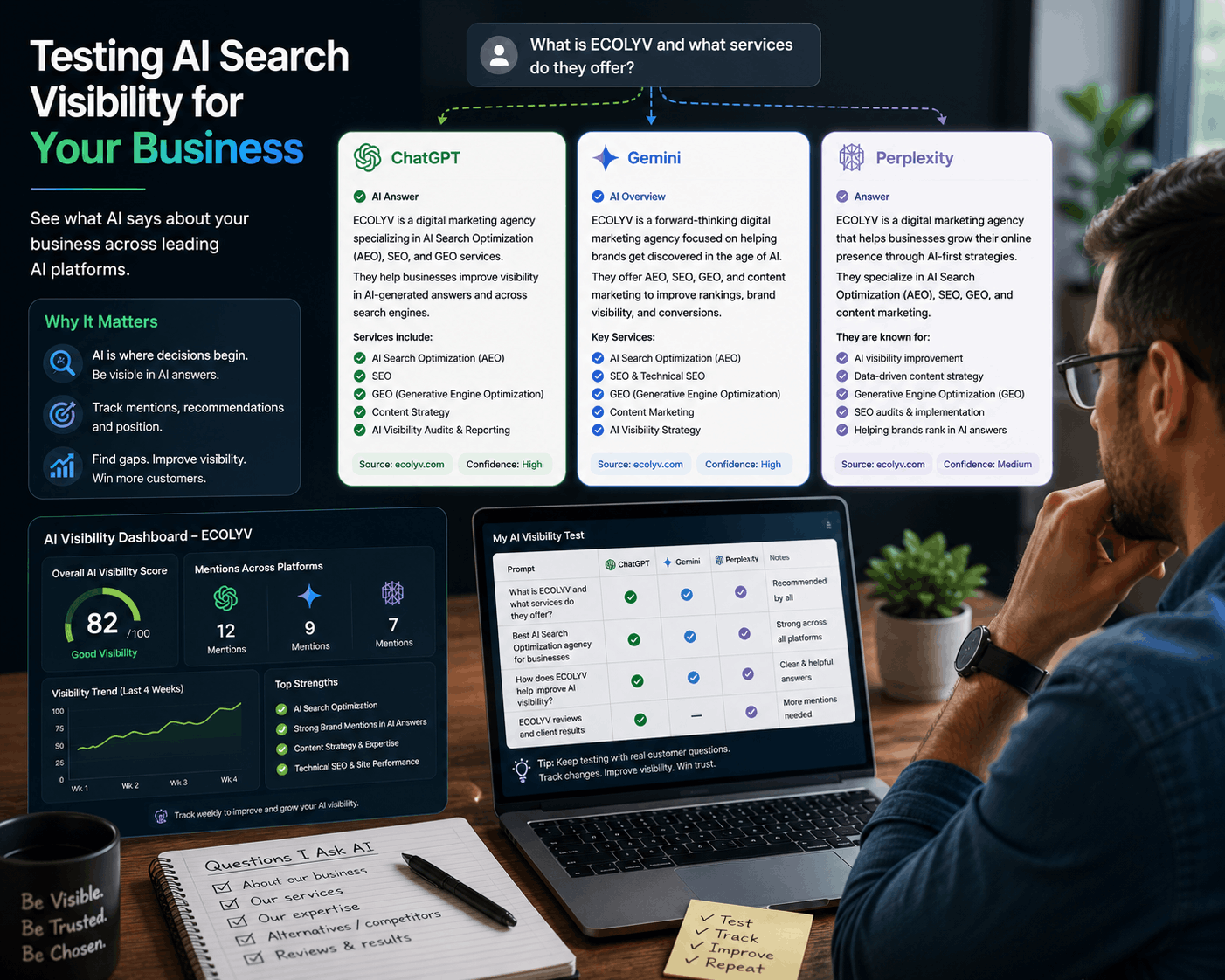
Quick answer: To check if your business is visible in AI search, ask ChatGPT, Gemini, and Perplexity the same real questions your customers would type, including both branded and non-branded phrasing. Note whether your business is named, how it is described, and whether competitors appear instead. Repeat weekly, since AI answers change often and a single check is only a snapshot.
Most business owners have never actually asked ChatGPT what it thinks of them. They check Google rankings obsessively but have no idea whether Gemini recommends them, whether Perplexity cites their website, or whether they are simply invisible to the AI systems a growing share of customers now rely on.
This guide walks through exactly how to check, in plain steps, without needing a paid tool to get started.
Why This Actually Matters Right Now
This is not a small or theoretical gap. A study reported by Search Engine Journal, based on 107,011 AI responses across eight platforms, found that nearly 90 percent of the brands tested had zero AI mention rate in the first quarter of 2026. That means most businesses are not losing a visibility fight. They have not entered it yet.
The audience on the other side of that gap is enormous. OpenAI has confirmed that ChatGPT reached 900 million weekly active users as of February 2026, and that number continues to climb. Every one of those users is a potential customer asking a question your business could be the answer to, if AI systems know enough about you to mention you.
It also is not enough to check just one platform. BrightEdge's AI Catalyst research, analyzing tens of thousands of identical prompts, found that AI platforms disagree on which brands to recommend for 61.9 percent of queries. Being visible in ChatGPT tells you almost nothing about whether you are visible in Gemini or Perplexity.
Step 1: Build a Real Prompt List
Do not test your business name alone. Write down 10 to 15 questions your actual customers would type, mixing two kinds of prompts.
- Branded prompts. Questions that include your business name directly, to confirm AI recognizes you exist at all.
- Non-branded prompts. Questions like best plumber in your city or top marketing agency for small businesses, which show whether AI recommends you without being asked by name.
Non-branded prompts are harder to win but far more valuable, since they represent the moment a potential customer is actually deciding who to choose.
A useful way to build this list is to pull from three sources. Start with your Google Search Console top queries, since these are questions people already type when looking for businesses like yours. Add the questions your sales or front desk team hears most often on calls, since these reflect real decision-making language rather than keyword guesses. Finally, add two or three comparison prompts, such as your business name versus a specific competitor, since these reveal how AI frames you relative to alternatives people are actively weighing.
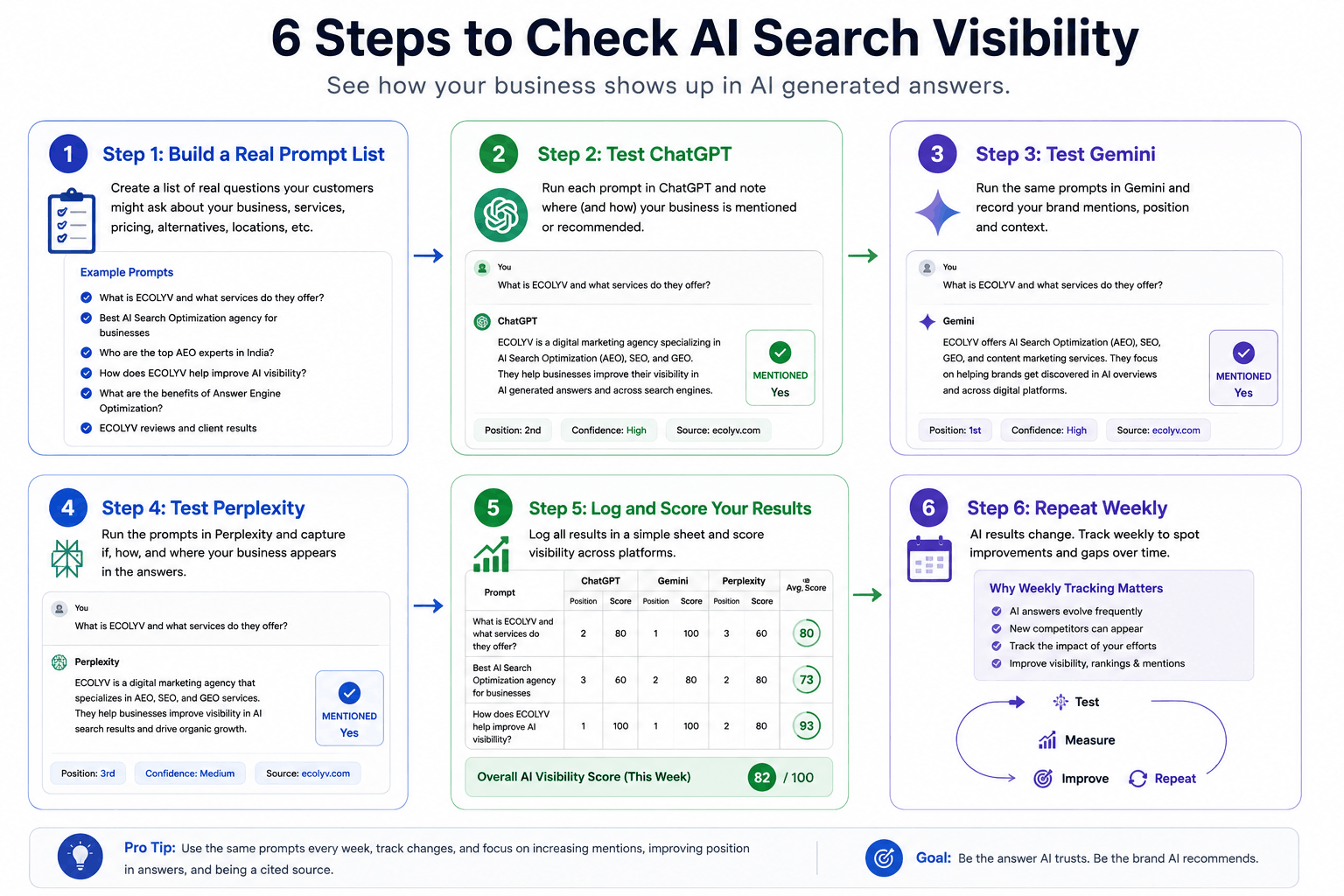
Step 2: Test ChatGPT
Run each prompt in ChatGPT twice: once with web browsing enabled, and once with it off. This reveals two different gaps. If you appear with browsing on but not off, your live web presence is working but you have not been absorbed into the model's underlying knowledge. If you appear in neither, the gap is deeper and needs both content and trust signal work.
Pay attention to phrasing too. ChatGPT tends to mention brands more often than it formally cites them as sources, so a mention without a link still counts as visibility worth tracking, even though it will not send referral traffic the way a citation does.
Step 3: Test Gemini
Run the same prompts in Gemini. Since Gemini is closely tied to Google's own index, strong traditional SEO and structured data tend to carry more weight here than in ChatGPT. If you rank well on Google but Gemini still ignores you, that is a clear signal your schema markup or entity information needs attention.
Gemini also tends to pull from Google Business Profile data for local queries, so if your profile is incomplete or inconsistent, that gap often shows up here before it shows up anywhere else.
Step 4: Test Perplexity
Run the same prompts in Perplexity and pay close attention to citations, not just mentions. Perplexity is built around visible source citations, so it is usually the easiest platform to audit precisely, since you can see exactly which pages it pulled information from. If a competitor's page keeps appearing as the cited source instead of yours, that page is likely doing something specific, like answering the question more directly or including data your content lacks.
Step 5: Log and Score Your Results
Keep a simple spreadsheet with one row per prompt and one column per platform. Mark whether your business was mentioned, how it was described, and which competitors appeared instead. Divide the number of prompts that named you by the total number tested to get a rough visibility score you can track over time.
Step 6: Repeat Weekly
A single check is only a snapshot. AI answers are not static, and the same prompt run twice in one week can produce different results. Retesting the same prompt list weekly is what turns a one-time curiosity into a usable visibility metric you can act on.
What to Look For Beyond a Simple Yes or No
Whether your business appears at all is only the first layer of the picture. The details underneath that yes or no tell you what to actually fix.
- Accuracy. Is the description of your business correct, or outdated and generic? An AI system repeating stale information usually means your entity data across the web is inconsistent.
- Position. Are you named first, or buried after several competitors? Position often reflects how strongly AI trusts your business relative to others in the response.
- Sentiment. Is the framing positive, neutral, or does it raise concerns? Neutral framing is common and not alarming on its own, but negative framing deserves immediate attention.
- Source. When a platform cites a source, is it your website, or a third-party directory talking about you instead? A citation pointing away from your own site means you are not controlling your own narrative.
How to Interpret a Low Score
If your business appears in fewer than a quarter of the prompts you tested, treat that as a starting baseline rather than a failure. Given that most brands tested in recent research show zero AI mentions at all, appearing in even a small share of responses puts you ahead of the majority. The goal of the first check is not a perfect score. It is a clear, honest baseline you can measure future improvement against.
Common Mistakes When Checking AI Visibility
- Testing only your own brand name instead of the questions customers actually ask
- Checking once and treating the result as permanent, rather than a snapshot
- Testing only one platform and assuming the result applies everywhere
- Ignoring how you are described when you do appear, not just whether you appear
- Never checking which competitors show up instead, which is often the most useful signal
A Simple Example: Before and After
Consider a local dental practice that assumed strong Google rankings meant strong AI visibility. Running a 12-prompt test across ChatGPT, Gemini, and Perplexity, the practice found it appeared in only 2 of 12 responses, both branded searches. Non-branded prompts like best dentist for anxious patients near me returned three competitors and never mentioned the practice at all.
Before: No FAQ content built around real patient questions, inconsistent business details across directories, and no active AI visibility tracking.
After: The practice added a detailed FAQ page answering the exact non-branded questions it had tested, corrected inconsistent listings, and began a weekly recheck. Within six weeks, it appeared in 7 of the same 12 prompts, including two non-branded ones.
Who Needs This Most
Any business competing on informational or comparison-style queries benefits from checking this regularly. That includes dentists, law firms, healthcare providers, HVAC and plumbing companies, consultants, and SaaS companies, since these are the categories where customers research heavily before deciding.
How This Connects to AI Search Optimization
Checking your visibility is only the diagnostic step. Fixing what the check reveals is a separate, ongoing effort.
- Our AI Visibility Checker automates this same testing process across multiple platforms and prompts at once, instead of running each check manually.
- A full AI Search Optimization strategy addresses the gaps a visibility check uncovers, from schema markup to content structure to external trust signals.
Checking without fixing tells you where you stand but does not move you forward. The two need to work together.
Key Takeaways
- Nearly 90 percent of brands tested in a recent large-scale study had zero AI mention rate, so most businesses have not started this work yet.
- Test branded and non-branded prompts separately, since non-branded visibility is harder to earn and more valuable.
- Check ChatGPT, Gemini, and Perplexity individually, since platforms disagree on brand recommendations more often than they agree.
- A single check is a snapshot. Weekly retesting is what makes the data useful.
- Checking visibility and fixing the gaps it reveals are two separate, connected steps.
FAQs
What is the fastest way to check if my business shows up in ChatGPT?
Open ChatGPT and ask it the questions your customers would actually type, such as best provider for your service in your city. Test with web browsing on and off, and note whether your business is named, described accurately, and recommended alongside competitors.
Do I need a paid tool to check my AI visibility?
No. Manual testing across ChatGPT, Gemini, and Perplexity works well for most small and mid-sized businesses. Paid AI visibility tools help once you need to track dozens of prompts weekly or benchmark against several competitors at scale.
Why does my business show up in ChatGPT but not Gemini?
Each AI engine pulls from different sources and weighs them differently. Gemini leans heavily on Google's own index and structured data, while ChatGPT draws more from its training data and live web search. Being strong in one does not guarantee visibility in another.
How often should I check my AI search visibility?
Weekly is a reasonable minimum, since AI answers can change from one query to the next even for the same prompt. A single check is only a snapshot, and results have been shown to shift significantly across repeated runs.
What does it mean if AI never mentions my business at all?
It usually means the AI system does not have enough structured, consistent, or authoritative information about your business to reference confidently. This is common and fixable through better schema markup, clearer content, and stronger trust signals like reviews and citations.
Should I test branded and non-branded prompts separately?
Yes. Branded prompts, like your business name directly, show whether AI recognizes you at all. Non-branded prompts, like best plumber near me, show whether AI recommends you without being asked by name, which is the harder and more valuable visibility to earn.
About the Author
Hitesh Chauhan is the founder of Ecolyv and has spent 5+ years working across IT, SaaS, and cybersecurity content, helping businesses get found through Google Business Profile optimization and, more recently, AI search visibility. He writes Ecolyv's AI Search Optimization guides based on what is actually working for clients, not general theory.
Want to See Your AI Visibility Score Right Now?
Run your business through our free AI Visibility Checker, or book a call and we will walk through the results with you and show you what to fix first.