 ECOLYV
Answer Engine Optimization: The Complete 2026 Guide
By Hitesh Chauhan | Updated August 2026 | ~9 min read
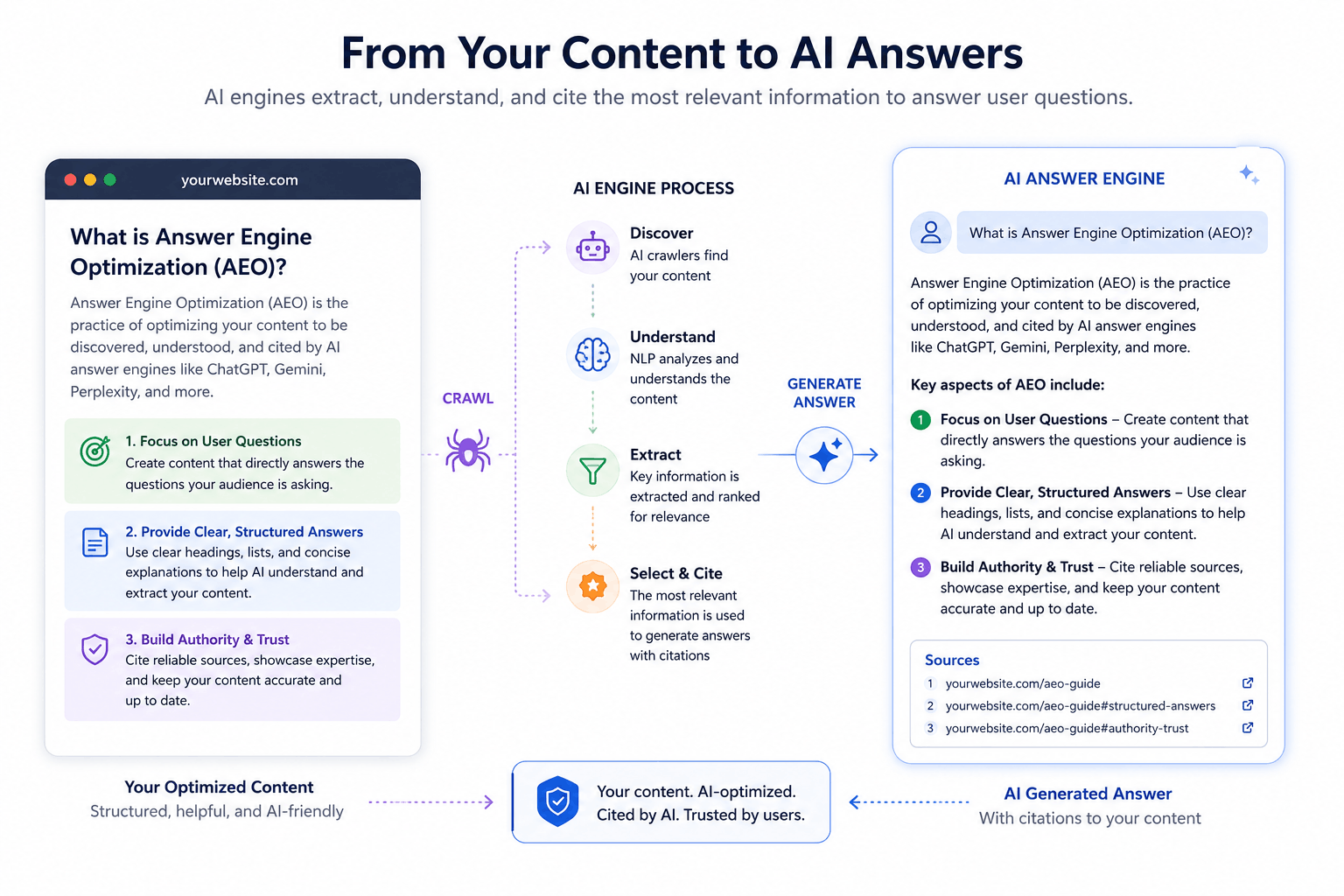
Quick answer: Answer Engine Optimization, or AEO, is the practice of structuring content so AI systems like ChatGPT, Gemini, and Perplexity can extract a clear answer and cite a business as the source. Instead of competing for a ranking position on a results page, AEO competes to become the actual sentence the AI delivers, using direct answers, clear structure, and proper schema markup.
Search used to end with a list of ten blue links. Increasingly, it ends with a single generated answer, and only one or two sources get credit for it. Answer Engine Optimization is the discipline built around earning that credit on purpose, rather than hoping it happens.
This guide covers what AEO actually means, how it differs from traditional SEO, why it matters now, and a practical framework for structuring content that AI systems can confidently extract and cite.
What Answer Engine Optimization Actually Means
AEO is the practice of structuring content, technical markup, and site architecture so AI answer engines recognize a page as a trustworthy, extractable source and cite it directly in a generated response. It applies across ChatGPT, Google AI Overviews, Gemini, and Perplexity, each of which pulls from different signals but rewards similar underlying qualities: clarity, directness, and verifiable specificity.
The term gained real traction once AI answer features moved from a novelty into the default way many people search. A user typing a question into ChatGPT or Perplexity today expects a synthesized answer, not a list of links to sort through themselves. AEO exists because that expectation changed the target businesses are optimizing for.
The shift is not small. Semrush data cited by Contently found that AI search visits grew 42.8 percent year over year, climbing from 15.6 billion to 27.4 billion visits between Q1 2025 and Q1 2026, while traditional Google search visits grew just 2.4 percent over the same period. The audience asking AI systems questions is still smaller than the audience using traditional search, but it is growing dramatically faster.
How Different AI Platforms Apply AEO
Treating every AI engine the same way is one of the more common mistakes businesses make. Each platform weighs signals differently.
ChatGPT draws from both its training data and live web search when browsing is enabled, so a business can be well represented in one mode and invisible in the other. Content that has been widely referenced across the web over time tends to perform well here.
Gemini is closely tied to Google's own index and structured data. Strong traditional SEO and clean schema markup carry more weight here than in most other engines.
Perplexity is built around visible, transparent citations, which makes it the easiest platform to audit directly. It also favors recently updated content more heavily than the others.
Optimizing for one platform in isolation leaves real visibility on the table in the others, which is why a genuine AEO program tests and adjusts across all three rather than assuming one covers them all.
How AEO Differs From Traditional SEO
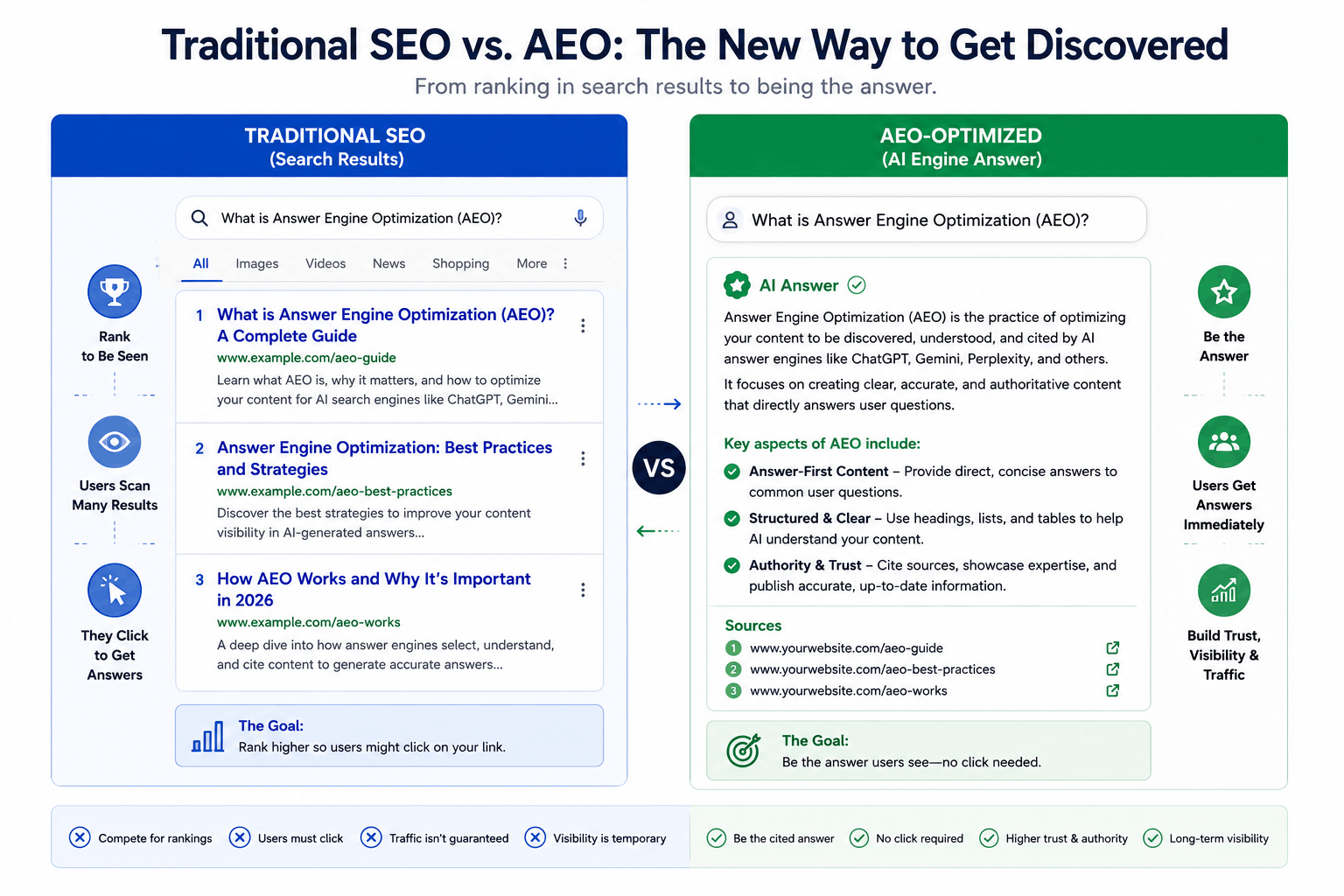
| Traditional SEO | Answer Engine Optimization |
|---|---|
| Optimizes for a ranking position | Optimizes for a citation inside the answer |
| Success measured by click-through rate | Success measured by mention and citation rate |
| Rewards keyword density and backlink volume | Rewards direct answers and verifiable specificity |
| Content built to persuade over a full page | Content built to answer within the first sentence or two |
These are not competing strategies. A page needs to be indexed and discovered before it can ever be extracted and cited, which means SEO fundamentals still form the base AEO is built on top of.
Why AEO Matters Right Now
Beyond growth in volume, the audience arriving through AI answers behaves differently. The same Semrush research found that AI search visitors are 4.4 times as valuable as the average traditional organic visitor, since they arrive having already read a synthesized comparison and tend to be further along in their decision.
That combination, a smaller but rapidly growing and higher-value audience, is exactly why ignoring AEO means quietly ceding high-intent buyers to whichever competitor the answer engine happens to choose instead.
The Three Core Principles of AEO
Structure. Content should lead with a direct answer, ideally within the first sentence or two of a section, followed by supporting detail. AI systems extract cleanly from pages organized this way and tend to skip pages that bury the answer in the middle of a paragraph. This is a genuine reversal of how most content has traditionally been written, where context and buildup come first and the answer arrives near the end.
Freshness. AirOps' 2026 State of AI Search Report, analyzing citation patterns across ChatGPT, Perplexity, and Google's AI systems, found that 83 percent of AI citations for commercial and evaluation-stage queries came from pages updated within the past 12 months. A page that once ranked well but has not been touched in two years is a weak candidate for citation, regardless of how authoritative it once was.
Verifiable specificity. Vague marketing language rarely gets cited. Specific, checkable facts, figures, and examples give AI systems something concrete to extract and attribute confidently. A sentence claiming a service is fast and reliable offers nothing to quote. A sentence stating a specific response time backed by a real figure does.
How to Structure Content for AEO
Turning these principles into practice comes down to a repeatable process for any page a business wants AI systems to cite.
- Lead with the answer. Open key sections with a direct, complete answer to the implied question before adding supporting context. A reader or an AI system should be able to stop after the first sentence and already have the core answer.
- Use headings phrased as questions. Headings written the way people actually ask, rather than generic topic labels, match how AI systems parse content for relevant sections and improve how easily a page maps to a real prompt.
- Add FAQ and HowTo schema. Structured markup gives AI systems an explicit, machine-readable version of the same answers already visible on the page, reducing the work the model has to do to extract them correctly.
- Support claims with specific data. Replace general statements with checkable numbers, dates, and sourced facts wherever possible, since specificity is one of the strongest predictors of citation.
- Refresh regularly. Revisit high-value pages on a quarterly cycle rather than publishing once and leaving them untouched for years, particularly for commercial and comparison content where freshness carries the most weight.
Common Mistakes in AEO
Most AEO failures are not about a lack of effort. They come from applying old content habits to a new format.
- Writing long introductions before ever answering the actual question
- Adding FAQ schema that does not match the visible on-page content word for word
- Treating AEO as a one-time project instead of an ongoing content discipline
- Focusing only on branded queries instead of the non-branded questions customers actually ask
- Publishing content once and never refreshing it as facts or context change
A Simple Example: Before and After
Consider a SaaS company's help center article explaining a common integration issue. The original version opens with three paragraphs of company background before ever describing the fix.
Before: The article buries the actual solution in paragraph four, has no FAQ schema, and has not been updated since the feature it describes was released.
After: The rewritten version opens with a one-sentence direct answer, adds a properly matched FAQ section with schema, and gets refreshed quarterly as the product changes. Within weeks, the page begins appearing as a cited source when users ask ChatGPT and Perplexity about the same issue.
Who Needs This Most
Any business that publishes informational or how-to content benefits from AEO, but it matters most for SaaS companies, healthcare providers, consultants, and any business competing on expertise rather than price alone, since these are exactly the categories where AI systems are asked to compare and recommend sources.
How This Connects to AI Search Optimization
AEO is one layer of a larger visibility strategy, not the whole of it.
- Our Answer Engine Optimization service applies this exact framework to a business's existing content, prioritizing the pages most likely to earn citations first.
- Our broader AI Search Optimization service combines AEO with technical SEO and entity trust signals into one coordinated program.
Well-structured content still needs a technically sound, crawlable site underneath it, and AEO delivers its best results as part of that larger foundation rather than in isolation.
Key Takeaways
- AEO is the practice of structuring content so AI systems can extract and cite it directly, rather than optimizing purely for a ranking position.
- AI search visits are growing far faster than traditional search, and the visitors arriving through AI answers convert at a notably higher rate.
- Structure, freshness, and verifiable specificity are the three variables that most reliably predict whether a page gets cited.
- AEO builds on SEO fundamentals rather than replacing them, and works best as part of a coordinated strategy.
- Small businesses with clear, well-structured content can be cited over larger competitors with thin content.
FAQs
What is Answer Engine Optimization in simple terms?
Answer Engine Optimization is the practice of structuring content so AI systems like ChatGPT, Gemini, and Perplexity can extract a clear answer and cite your business as the source. Instead of competing for a ranking position, AEO competes to become the sentence the AI actually delivers.
Is AEO replacing SEO?
No. AEO builds on SEO rather than replacing it. Strong technical SEO still gets your content indexed and discovered in the first place. AEO adds the structure, clarity, and direct-answer formatting that AI systems need to extract and cite content once they find it.
How long does it take to see results from AEO?
Most businesses see measurable shifts in AI mentions within four to eight weeks of restructuring key pages and adding proper schema, though full citation consistency across multiple AI platforms typically takes a few months of sustained work.
What schema types matter most for AEO?
FAQPage, HowTo, Article, and Person schema for author attribution tend to have the most impact. Schema works best when it accurately reflects visible content on the page rather than marking up hidden or implied information.
Does AEO work for small local businesses, not just big brands?
Yes. AI systems do not weigh brand size the way traditional rankings sometimes do. A small business with clear, well-structured, accurate content can be cited over a larger competitor with thin or poorly organized information.
How is AEO different from writing good content in general?
Good content persuades a human reader over the course of a page. AEO content answers a specific question directly within the first sentence or two, then supports that answer with specific, checkable facts, which is the format AI systems can extract and quote cleanly.
About the Author
Hitesh Chauhan is the founder of Ecolyv and has spent 5+ years working across IT, SaaS, and cybersecurity content, helping businesses get found through Google Business Profile optimization and, more recently, AI search visibility. He writes Ecolyv's AI Search Optimization guides based on what is actually working for clients, not general theory.
Ready to Get Cited Instead of Skipped?
Get a free AI visibility check and a clear plan for restructuring your highest-value content to earn real citations.