 ECOLYV
AIO vs AEO vs GEO: What Is the Difference and Do You Need All Three?
By Hitesh Chauhan, Founder, Ecolyv | Updated August 2026 | ~8 min read
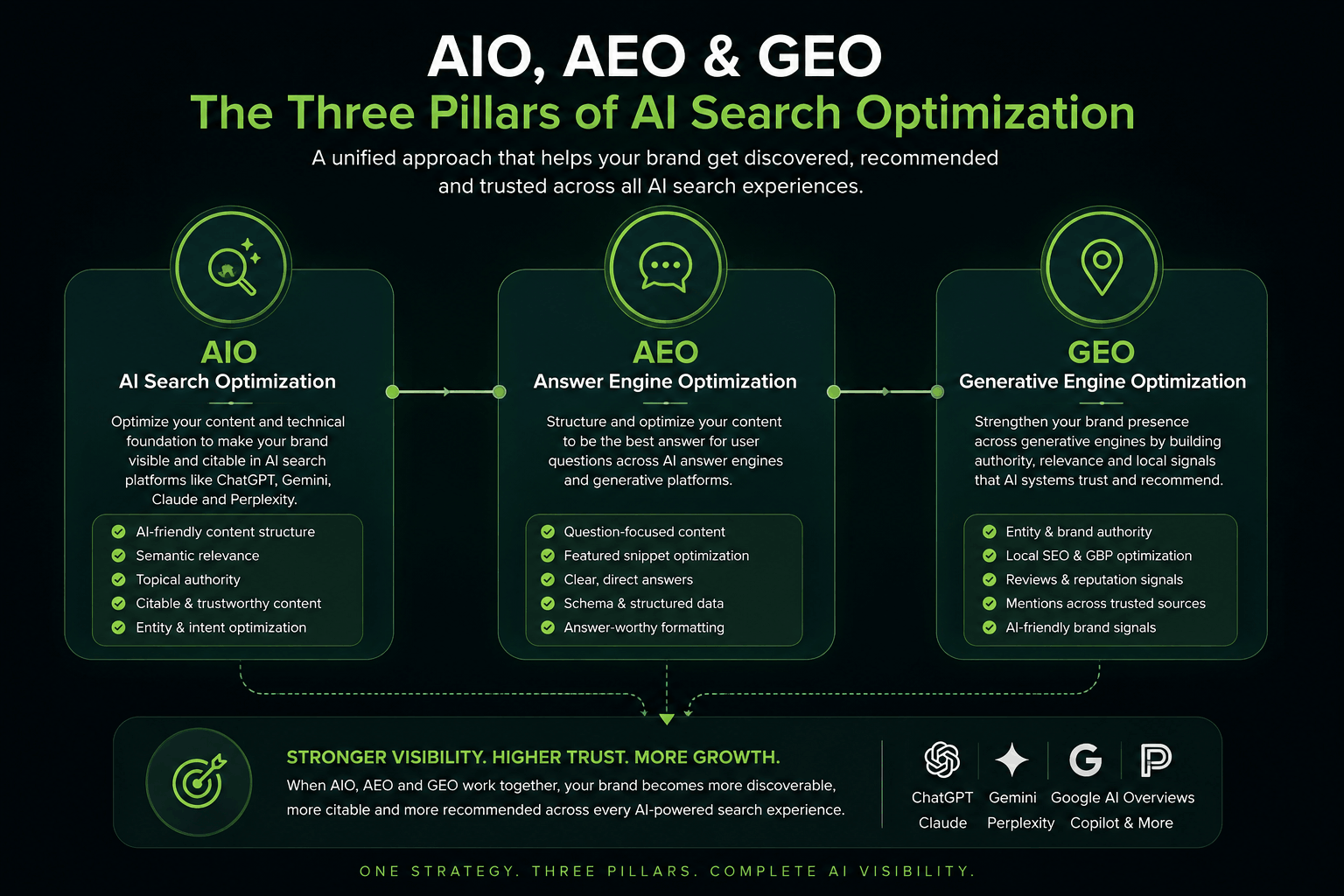
Quick answer: AIO, AEO, and GEO are three connected parts of AI search optimization, not three separate strategies to choose between. AIO makes a website technically readable to AI systems. AEO structures content so AI can extract a direct answer from it. GEO builds the outside trust signals that convince AI to recommend a business by name. Most businesses need all three, since each one depends on the layer before it.
Why This Gets Confusing
AIO, AEO, and GEO are newer terms, and different agencies and publications sometimes define them slightly differently. That inconsistency makes it easy to assume they are competing approaches, when in practice they describe three stages of the same process. Understanding where one ends and the next begins makes it much easier to know what actually needs attention.
The confusion is understandable. All three terms emerged around the same time, in response to the same underlying shift: AI systems replacing traditional search results with direct, generated answers. Because they arrived together, it is tempting to treat them as three versions of the same idea rather than three distinct, sequential parts of one strategy. Separating them clearly from the start makes every later decision easier, from which schema to prioritize to which content to rewrite first.
What Is AIO?
AIO, or AI Optimization, is the technical foundation. It covers everything that allows an AI crawler or model to access and correctly interpret a website in the first place.
Core elements of AIO include the following.
- Schema markup that describes what a business is, what it offers, and where it operates
- Clean, semantic HTML rather than heavy, code-bloated page builders
- Fast-loading, crawlable pages
- Consistent business information across the website itself
Without AIO, an AI system may be able to reach a page but struggle to understand what is actually on it. Good content and strong trust signals cannot help if the underlying technical structure blocks AI from reading them correctly.
What Is AEO?
AEO, or Answer Engine Optimization, is the content layer. Once AI can read a page, AEO determines whether that page gives AI something specific and quotable to work with.
Core elements of AEO include the following.
- Answering the actual question within the first sentence or two of a section
- Using headings phrased the way real people ask questions
- Including FAQ and HowTo style content built from real customer queries
- Supporting claims with specific, checkable facts rather than general marketing language
A page can be technically perfect from an AIO standpoint and still fail at AEO if the content is written to persuade a human reader rather than to directly answer a question. AI systems tend to skip past persuasive framing and look for a clear, factual answer instead.
What Is GEO?
GEO, or Generative Engine Optimization, is the trust layer. Even a technically sound page with well-structured answers still needs outside confirmation that the business is legitimate and worth recommending.
Core elements of GEO include the following.
- Review volume, recency, and overall sentiment
- Citations and mentions on other authoritative websites
- Consistent business details across directories and platforms
- General reputation signals across the wider web
GEO is the layer most businesses overlook, largely because it is not something that lives on their own website. It has to be earned externally, over time, rather than written once and left alone.
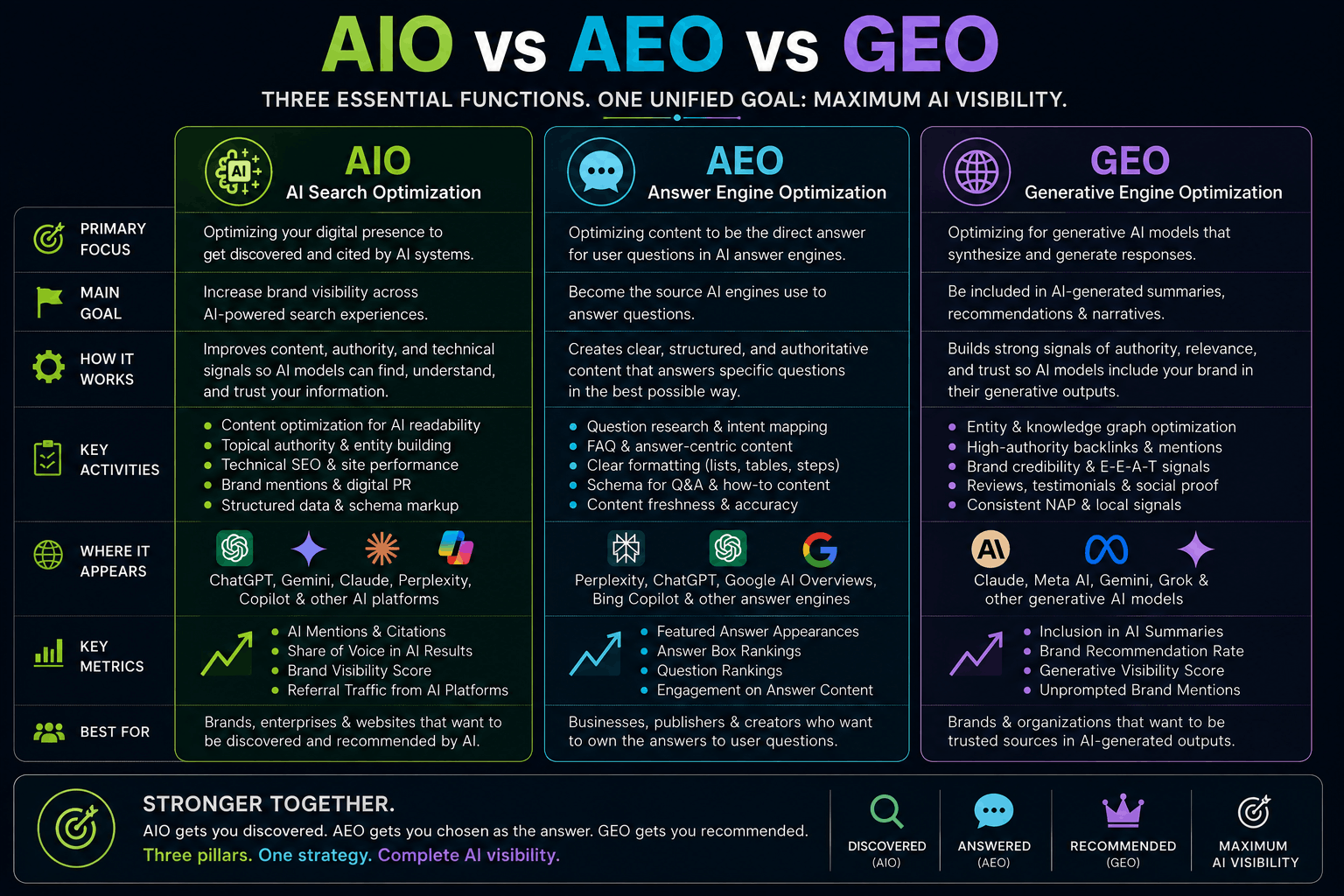
AIO vs AEO vs GEO: Side-by-Side Comparison
| Layer | What It Solves | Where It Lives | Example Action |
|---|---|---|---|
| AIO | Can AI read and understand the site | Website code and structure | Adding schema markup |
| AEO | Does the content answer the question directly | On-page content | Writing question-first FAQ sections |
| GEO | Does AI trust the business enough to recommend it | Reviews, citations, external mentions | Managing and growing reviews |
Why Businesses Need All Three, Not Just One
These three layers build on each other in sequence. Skipping one weakens the others, regardless of how well the remaining two are executed.
A site with strong AEO content but weak AIO may never get crawled correctly, so the well-written content never gets seen. A site with strong AIO and AEO but no GEO may be technically readable and well structured, yet still get passed over in favor of a competitor with more visible trust signals. A site with strong GEO alone, meaning good reviews and mentions, but poor AIO and AEO gives AI a trusted name with nothing specific to say about it.
Treating AIO, AEO, and GEO as three legs of the same table is a more accurate way to think about this than treating them as competing options.
Where to Start If You Are Just Beginning
For most businesses starting from zero, the practical order is AIO first, then AEO, then GEO.
- Start with AIO. Confirm AI can actually access and understand the site before investing heavily in content or trust building.
- Move to AEO. Rewrite key pages and build FAQ content once the technical foundation is solid.
- Build GEO continuously. Begin generating reviews, fixing directory inconsistencies, and earning citations, and treat this as an ongoing effort rather than a one-time project.
This is the same sequence Ecolyv follows with every client, since attempting GEO before AIO and AEO are in place tends to waste effort building trust in a business AI still cannot properly read or quote.
How This Looks in Practice
Consider a dental clinic trying to improve its AI visibility. Looking at the situation through each layer separately makes it easier to see what is actually missing.
AIO check: Does the site have LocalBusiness and Dentist schema in place? Is the HTML clean enough for a crawler to parse without confusion? Are name, address, and phone number consistent across the site itself?
AEO check: Does the site directly answer questions like "does this dentist accept walk-ins" or "how much does a cleaning cost" within the first sentence of a relevant page, or is that information buried inside a long paragraph about the practice's history?
GEO check: Are there enough recent, positive reviews on Google? Is the clinic mentioned on local directories and health platforms with consistent details? Do other dental or health-related sites reference the practice at all?
Most clinics score reasonably well on one of these three and poorly on the other two. A clinic with excellent reviews but a slow, unstructured website has strong GEO and weak AIO. A clinic with a fast, well-coded site but generic, persuasive-only content has strong AIO and weak AEO. Identifying which layer is actually the weak point, rather than assuming the whole strategy needs to be rebuilt, is usually the fastest way to see measurable improvement.
Which Layer Tends to Deliver Results First
AIO fixes are typically the fastest to implement and the fastest for AI systems to notice, since schema and technical corrections can be picked up on the next crawl. AEO improvements usually take a few weeks longer to show impact, since new content needs to be indexed and evaluated. GEO gains are the slowest, often taking several months, since trust signals build gradually through accumulated reviews and citations rather than a single update.
This is worth knowing when setting expectations. A business investing in all three layers at once should expect early, visible movement from AIO and AEO work, with GEO's effect compounding more gradually over time.
Where Each Layer Connects to Ecolyv's Services
These three layers are not abstract concepts. Each one maps directly to specific, ongoing work.
- AIO work overlaps heavily with what we cover in AI Website Solutions, since the technical foundation has to be built into the site itself rather than added on top later.
- AEO work is the core focus of Answer Engine Optimization, where content gets restructured around direct, extractable answers instead of persuasive copy.
- GEO work leans heavily on Google Business Profile Optimization, since GBP is one of the most consistently updated, high-trust data sources AI systems check for local businesses.
None of these services function well in isolation from the others. A well-optimized Google Business Profile still needs a website that can back up its claims, and a well-structured website still needs enough external trust signals for AI to take the content seriously.
Common Misconceptions
- Assuming AEO is just SEO with different branding. AEO content is written to be extracted and quoted, not to rank through keyword density.
- Assuming GEO is only about backlinks. Backlinks are one part of GEO, but reviews, directory consistency, and brand mentions matter just as much.
- Assuming AIO is a one-time technical fix. Schema and site structure need regular maintenance as AI crawling standards continue to evolve.
- Assuming a business only needs one of the three. In practice, the three layers work together, and neglecting one limits the return on the other two.
FAQs
What is the main difference between AIO, AEO, and GEO?
AIO focuses on technical readability so AI systems can crawl and understand a website. AEO focuses on structuring content so AI can extract direct answers from it. GEO focuses on earning outside trust signals, such as reviews and citations, that convince AI to recommend a business by name.
Do I need AIO, AEO, and GEO, or can I choose just one?
Most businesses need all three, since each layer depends on the one before it. Strong AEO content on a site with poor AIO is hard for AI to crawl in the first place. Strong AIO and AEO without GEO gives AI nothing external to confirm the business is trustworthy.
Which of the three should I start with?
Start with AIO. If AI systems cannot read your site cleanly, neither AEO content nor GEO trust signals will matter, since the AI has no reliable way to access them in the first place.
Is GEO the same as backlink building?
Not exactly. Backlink building is one part of GEO, but GEO also includes review management, citation consistency across directories, and general brand mentions across the web. It is a broader trust-signal strategy than backlinks alone.
How is AEO different from writing good SEO content?
SEO content is often written to persuade a reader and rank for keywords. AEO content is written to directly answer a specific question in a format AI can lift and quote, usually within the first sentence or two, with supporting facts rather than persuasive language.
Can a small business handle AIO, AEO, and GEO without an agency?
Basic AIO and AEO steps, such as adding schema and rewriting pages question first, are achievable for a small business owner. GEO is harder to manage alone at scale, since it requires ongoing review generation, directory consistency, and citation building across many platforms.
Key Takeaways
- AIO, AEO, and GEO are three connected layers of AI search optimization, not three separate strategies to choose between.
- AIO is the technical foundation, AEO is the content layer, and GEO is the outside trust layer.
- Skipping any one layer limits the effectiveness of the other two, regardless of how well those two are executed.
- The practical starting order for most businesses is AIO, then AEO, then GEO as an ongoing effort.
- Common mistakes include treating AEO as rebranded SEO, treating GEO as only backlinks, and treating AIO as a one-time fix.
About the Author
Hitesh Chauhan is the founder of Ecolyv and has spent 5+ years working across IT, SaaS, and cybersecurity content, helping businesses get found through Google Business Profile optimization and, more recently, AI search visibility. He writes Ecolyv's AI Search Optimization guides based on what is actually working for clients, not general theory.
Not Sure Which Layer Your Business Is Missing?
Book a free strategy call with an AI visibility expert. We will show you exactly where AIO, AEO, and GEO currently stand for your business, and what to fix first.