 ECOLYV
How Much Does AI Search Optimization Cost? 2026 Pricing Guide
By Hitesh Chauhan | Updated August 2026 | ~8 min read
Quick answer: AI search optimization typically costs between 800 and 6,000 dollars per month for small and mid-sized businesses in 2026, with entry-level local programs starting around 800 dollars and enterprise programs reaching 15,000 dollars or more. One-time AI visibility audits generally run 1,500 to 5,000 dollars. Price depends mainly on how many locations, AI platforms, and content pieces the program covers.
Ask five agencies what AI search optimization costs and you will likely get five different answers, some a thousand dollars apart for what sounds like the same service. That gap is not random. It reflects real differences in scope, and understanding those differences is the fastest way to know whether a quote is fair.
This guide breaks down real 2026 market pricing by business size, what actually drives the cost up or down, and how to tell a genuine AI optimization program from repackaged SEO with a new label.
Why the Price Range Is So Wide
The term AI search optimization gets applied to several distinct categories of work, and most quotes only cover a portion of them. Answer Engine Optimization restructures content so AI systems can extract a clean answer. Generative Engine Optimization builds the outside trust signals, like reviews and citations, that convince AI to recommend a business by name. Ongoing monitoring tracks visibility across platforms over time. A quote that covers all three will cost more than one covering just one, even if both are labeled the same way.
Industry pricing research from WebFX puts the full range plainly. Agency pricing for generative engine optimization spans roughly 1,500 to 50,000 dollars or more per month, depending on business size, website complexity, and how much of the strategy is included. That is a wide band, but it narrows quickly once you know your own scope.
Another reason prices vary so much is that the field is genuinely new. There is no standardized package the way there is for, say, a basic local SEO audit. Two agencies quoting the same business might structure their scope entirely differently, one bundling content production into the retainer and the other billing it separately. Reading the deliverables list matters more than comparing the headline number.
2026 Pricing by Business Type
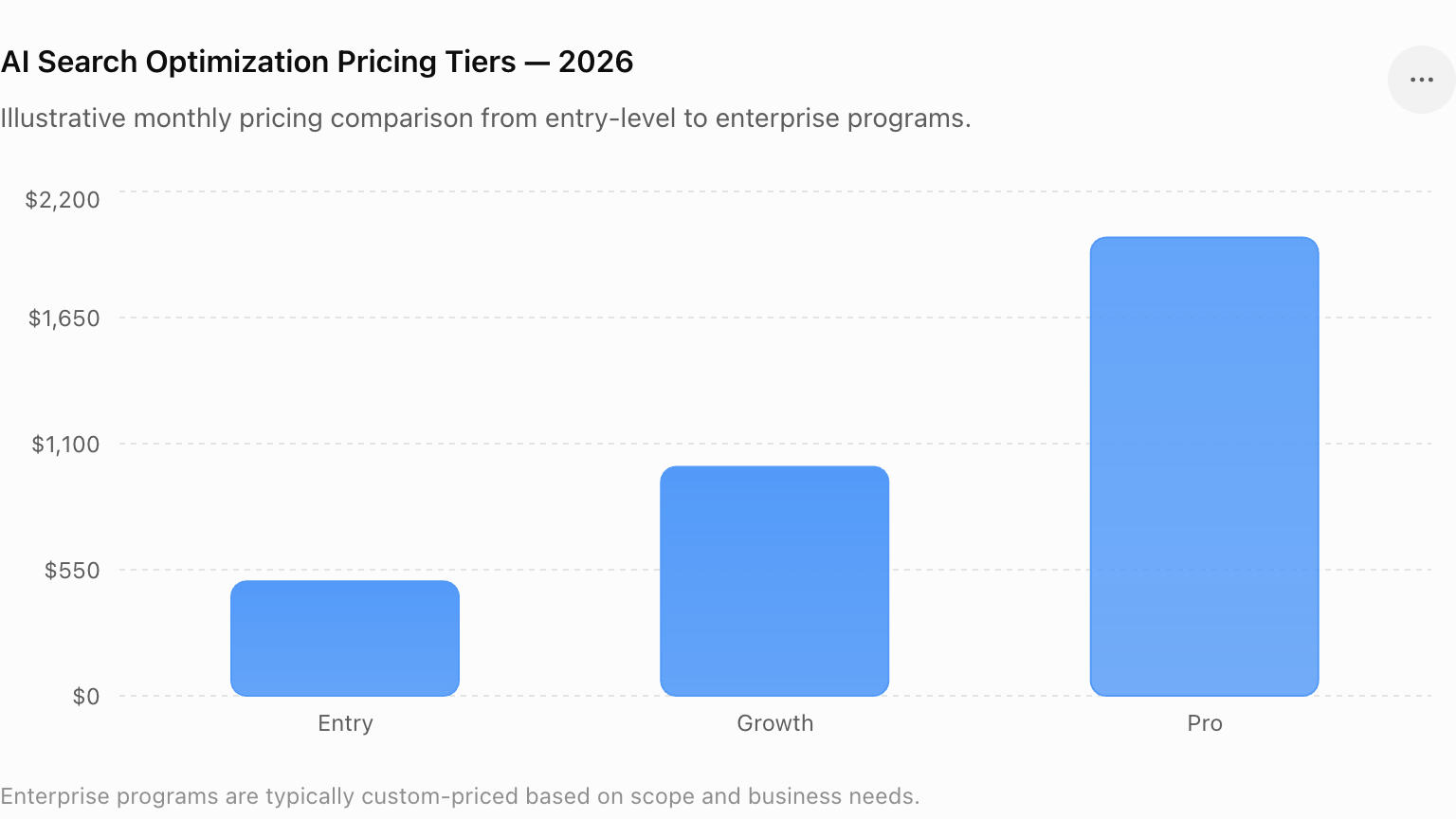
For most small and local businesses, the useful range is far narrower than the industry-wide extremes suggest. Research focused specifically on local service businesses found that AI search optimization for a single-location local business typically runs 800 to 3,000 dollars per month, with multi-location and specialty firms landing at the higher end. The table below reflects how that spending typically breaks down as a business grows in size and competitive pressure.
| Business Type | Typical Monthly Range | What It Usually Covers |
|---|---|---|
| Single-location local business | $800 – $1,500 | NAP cleanup, GBP optimization, basic schema, 1-2 platform monitoring |
| Multi-location or regional business | $1,500 – $3,500 | Full schema, content restructuring, 2-3 platform monitoring, quarterly audits |
| Mid-market / competitive niche | $3,000 – $8,000 | Content production, entity building, weekly multi-platform tracking |
| Enterprise / multi-vertical | $8,000 – $25,000+ | Full-stack AEO and GEO, dedicated content team, custom reporting |
Most businesses reading this guide fall into the first two rows. Jumping straight to a mid-market or enterprise program before the fundamentals are in place, like consistent business listings and basic schema, usually means paying for sophistication the business is not yet positioned to benefit from.
What Actually Drives the Price
- Number of locations. Each additional location multiplies the directory, citation, and Google Business Profile work involved.
- Number of AI platforms covered. Monitoring and optimizing for ChatGPT, Gemini, and Perplexity together costs more than covering just one, since each platform pulls from different sources and requires separate testing.
- Content volume. Programs that include ongoing content production, not just technical fixes, carry higher monthly fees, since writing genuinely useful FAQ and answer-first content takes real time per page.
- Competitiveness of the niche. Crowded categories like law firms and healthcare require more content and stronger trust signals to stand out, which pushes cost upward even for a single location.
- Reporting and audit frequency. Weekly multi-platform tracking costs more to deliver than a quarterly check-in, since it requires more analyst time per cycle.
DIY vs Agency vs In-House
There are three real paths, and the right one depends on scale, not just budget.
DIY. A business owner can run a manual visibility audit and clean up directory listings in an afternoon, at no cost beyond time. This works for a single-location business with a light content need, though it requires someone willing to repeat the audit regularly, since a one-time check quickly goes stale.
Agency retainer. Most small and mid-sized businesses land here, paying a monthly fee for ongoing monitoring, content, and technical work without hiring internally. This is usually the most cost-efficient option once the work needed exceeds a few hours a month.
In-house hire. Larger or highly competitive businesses sometimes bring this work in-house, which typically costs more in salary than an agency retainer but makes sense once the workload is constant and substantial enough to justify a full-time role.
Red Flags Worth Watching For
Not every pricing difference reflects genuine scope. Some reflect an agency selling old services under a new label.
- Vague deliverables that never mention specific AI platforms by name
- No willingness to show a current AI visibility baseline before the engagement starts
- Setup fees that exceed twice the monthly retainer for basic directory work
- Promises of guaranteed AI citations, since citations are earned through trust signals, not purchased placements
- Tool costs passed through at a heavy markup instead of billed near retail
Common Mistakes When Evaluating Pricing
Most pricing disappointment comes down to a mismatch between what was assumed and what was actually purchased. These are the mistakes that cause that mismatch most often.
- Comparing quotes without confirming they cover the same scope of work
- Assuming the cheapest option is the best value without checking what is excluded
- Signing a retainer without seeing a current AI visibility baseline first
- Paying for platform coverage that does not match where your actual customers search
- Overlooking setup fees that inflate the real first-month cost significantly
A Simple Example: Is It Worth the Cost
Consider a regional HVAC company paying 1,800 dollars a month for a multi-location AI search program. If the average service call is worth 350 dollars, the program only needs to generate roughly one additional booked job every three weeks to fully cover its cost. Businesses with high average job values, like specialty contractors or dental practices, often reach that breakeven point faster, since AI-referred leads tend to arrive already narrowed down to a short list rather than comparison shopping from scratch.
The same math looks different for a business with thin margins per transaction, like a low-cost retail product. In that case, the volume of AI-referred traffic matters more than the per-lead value, and a smaller, more targeted entry-level program often makes more financial sense than jumping straight to a mid-market retainer.
Who Needs This Most
Businesses with high-ticket services and heavy pre-purchase research, like dentists, law firms, HVAC and roofing companies, and healthcare providers, tend to see the clearest return, since a single converted lead often outweighs a full month of program cost. Multi-location businesses and specialty consultants also tend to justify higher-tier spending, since the visibility gap compounds across each additional location or service line.
How This Connects to AI Search Optimization Services
Pricing only makes sense once it is matched to the right scope for your business. A quote that sounds expensive in isolation might be entirely reasonable once you know it covers three platforms, quarterly content, and multi-location schema work, and a cheap quote might exclude exactly the parts your business needs most.
- Our AI Search Optimization service page breaks down exactly what is included at each tier, matched to the ranges covered in this guide.
- Our AI Visibility Checker gives you a free baseline before you spend anything, so any quote you receive can be measured against where you actually stand today.
A fair quote should always be able to point back to a specific, current gap in your visibility, not a generic package price.
Key Takeaways
- Most small and mid-sized businesses pay between 800 and 6,000 dollars per month, with local single-location businesses at the lower end.
- Price scales with the number of locations, AI platforms covered, and content volume, not just the provider's reputation.
- One-time audits, typically 1,500 to 5,000 dollars, are a lower-risk way to establish a baseline before committing to a retainer.
- DIY, agency, and in-house each make sense at different scales, not one universally right choice.
- A fair quote should reference your actual current visibility gap, not a flat, generic package.
FAQs
How much does AI search optimization cost per month?
Most small and mid-sized businesses pay between 800 and 6,000 dollars per month, depending on how many locations, AI platforms, and pieces of content are covered. Local service businesses with a single location typically land near the lower end, while multi-location or high-competition brands land closer to the upper end.
Is AI search optimization more expensive than traditional SEO?
It often costs slightly more than a comparable traditional SEO retainer, since it typically covers additional work like schema markup, entity consistency across directories, and monitoring across multiple AI platforms. In practice, most agencies now bundle both into one integrated retainer rather than pricing them separately.
Can I do AI search optimization myself without an agency?
Some parts are DIY-friendly, like cleaning up business listings and writing FAQ content. Technical work like schema implementation and ongoing multi-platform monitoring is harder to sustain without either technical skill or dedicated time each week, which is why many small businesses eventually move to a paid tool or an agency.
What is a one-time AI visibility audit and what does it cost?
A one-time audit tests how your business currently appears across AI platforms and identifies specific gaps to fix, without an ongoing retainer. These typically cost between 1,500 and 5,000 dollars depending on website size and how many platforms and prompts are tested.
How do I know if an agency is just repackaging SEO as AI optimization?
Ask specifically what AI platforms they test, how often they retest, and whether they can show you a current visibility baseline for your business. An agency doing real AI optimization work can answer these questions concretely rather than describing general SEO tactics with new labels attached.
Is AI search optimization worth the cost for a small local business?
For most local service businesses with average job values over a few hundred dollars, yes. AI-referred leads have been reported to convert at a notably higher rate than typical directory leads, and a single additional job per month often covers the monthly cost of a modest campaign.
About the Author
Hitesh Chauhan is the founder of Ecolyv and has spent 5+ years working across IT, SaaS, and cybersecurity content, helping businesses get found through Google Business Profile optimization and, more recently, AI search visibility. He writes Ecolyv's AI Search Optimization guides based on what is actually working for clients, not general theory.
Want a Quote Matched to Your Actual Visibility Gap?
Get a free AI visibility check first, then a clear, scoped price based on what your business actually needs, not a flat package.